The Bar
Nine of our Founders reported across four sessions. Revenue growth among the eight that report a revenue line ran from 20% to 104%. Five of the nine fell anyway, one by 19.0% on a day it raised full-year guidance. Inside: what happened to Datadog a week after we spotlighted it, SpaceX's first quarter as a public company, the setup into Nebius and CoreWeave, which report within twenty-four hours of each other this week, and a jobs number that changed the rate conversation.
Opening Bell
Welcome! At Founder ETFs, we help RIAs close the Founder Gap hiding in their clients' portfolios.
According to Bain & Company, Founder-Led companies in the S&P 500 generated total shareholder returns (TSR) 3.1x those of non-founder-led peers from 1990 to 2014, and 2.1x from 2015 to 2024. Past performance does not guarantee future results. Yet our research shows the 300 largest US equity ETFs (90% category AUM) own just 12.55% Founders. We built the Founders 100 ETF (100% Founders) to help close that gap.
Michael and I aren't a faceless asset manager. When you call, email, or text, you get us.
We're your partners: sharing our fundamental research, our highest-conviction Founder ideas, and following our disciplined, 80%+ rules-based process designed to help remove emotional decision making during periods of fear and greed. As two of the largest FFF shareholders, we plan to be fully invested alongside you for the next 30 years.
Last week we wrote that the market had started grading AI spending on the return it produces. This week the grading got harder. Datadog beat on revenue and on earnings, raised its full-year revenue, operating income and earnings guidance, and fell 19.0% in one session. Astera Labs grew revenue 104%, guided the September quarter to roughly 40% sequential growth, and fell 12.0%. AMD posted record revenue, guided about 4% above consensus, and fell 7.0%. Palantir grew revenue 93% and rose 29.5%.
Two things appear to have separated them, and we think both were at work. The first is what the forward numbers implied. Palantir raised its full-year revenue guidance by roughly half a billion dollars; Datadog's September guidance implies growth slowing to about 29% from 36%, and management said its largest customer is reducing usage. The second is where each stock started. Astera Labs had risen 45% in the four sessions before it reported. AMD had risen 20.7%. A quarter that would have been received well from a lower starting price was received badly from a higher one.
We own Founders on both sides of this and the week was not a clean one for us. We featured Olivier Pomel and Datadog in last week's Spotlight at a $300 estimate of value, and the stock closed Thursday at $229.29. FFF held Datadog when we published that Spotlight and holds it now. The operating results held up and we believe the long-term thesis is intact. The estimate did not hold up, and Conviction Corner deals with that directly. Past performance does not guarantee future results.
We are here to answer your questions. Welcome to Issue #13.
Michael & Lauren
Founder Spotlight
Arkady Volozh at Nebius
Co-Founder & CEO · Nebius Group N.V. (NBIS), an FFF holding · Reports Wednesday, August 12, before the open
Nebius is what is left of Yandex. Arkady Volozh built that company into Russia's dominant search engine starting in the late 1990s. Trading was suspended in February 2022 after the invasion of Ukraine, the group divested its Russian businesses, and in August 2024 what remained was renamed Nebius Group. Volozh took the international assets, the data center engineering and the cloud platform and rebuilt them in Amsterdam; roughly 1,100 employees relocated out of Russia with the divested businesses. He returned to the chief executive seat in 2024 and trading resumed on Nasdaq that October. A family trust for Volozh holds about 11% of the economics and roughly 52% of the voting power, which makes him the largest individual holder and gives the Founder Factor an unusually literal form here.
What has changed. For most of Nebius's short public life the argument was about whether the demand was real. First-quarter AI cloud revenue was $389.7 million, up 841% year over year, on group revenue of $399.0 million. Annualized run-rate revenue, the company's measure of contracted and recurring revenue at the end of a period, reached $1.92 billion at the end of March against guidance of $7 billion to $9 billion by the end of 2026. On the first-quarter call management said Nebius has been sold out for several consecutive quarters and typically sees "4 or more customers competing for every GPU we bring online." In our view the question has moved from demand to execution: whether secured power converts into connected, revenue-generating capacity fast enough to collect on it.
Why we think the economics are geared to scarcity
1. Nebius is buying the bottleneck. Eighteen months ago the constraint was GPUs. Today it is powered, interconnected, deployable data center capacity, because a GPU earns nothing until it sits in a site with secured power, grid interconnection and cooling. Nebius raised its contracted-power guidance to more than 4 gigawatts by year end, from more than 3 gigawatts at the fourth quarter, and management said owned capacity now accounts for more than 75% of total contracted power. It broke ground in May on a gigawatt-scale site in Independence, Missouri, and has secured power for a deployment of up to 1.2 gigawatts in Pennsylvania, ramping from 250 to 300 megawatts by the end of 2027.
2. The marginal supplier into a sold-out market sets the price. When demand runs ahead of the pace at which new powered capacity arrives, the newest capacity clears at the most favorable prices. AI cloud adjusted EBITDA margin reached 45% in the first quarter, up from 24% in the fourth quarter of 2025, and group gross margin was 74%. Management also reported record customer prepayments and lengthening contract durations.
3. Owned capacity is operating leverage in both directions. Because the model is owned and capital-intensive, incremental revenue spreads across a largely fixed cost base, so utilization and pricing compound into margin. The same structure works against the company if capacity idles. We believe demand holds, based on falling inference cost per token, hyperscaler capital spending funded from operating cash flow, and rising AI intensity per user. That is a belief, not a forecast, and the risks below are the reasons it could be wrong.
4. Vertical integration is the Founder Factor at work. Nebius owns the stack from power at the bottom, through GPU cloud, orchestration and managed Kubernetes, up into inference and agentic software via its Token Factory platform. It has added to that layer by acquiring Eigen AI, which closed in June, hiring Clarifai's core engineering team and licensing its inference stack in May, and agreeing in February to acquire the agentic search company Tavily. In our view the reward in this cycle goes to whoever owns the most of the stack rather than to whoever invents or merely adopts, and Founder-Led operators are the ones with the conviction to reach for the whole thing.
One development from July complicates that framing and is worth watching. Nebius introduced an asset-light model in which infrastructure partners finance and own the hardware and facilities while Nebius supplies the architecture, software, maintenance and customer access in exchange for revenue share, licensing fees and commissions. The company says it has entered initial arrangements. If that model scales, the relationship between capital spending and run-rate revenue changes materially, in both directions.
The cap table. NVIDIA participated in a $700 million private placement in December 2024 alongside Accel and accounts managed by Orbis Investments; the company did not disclose individual investor amounts. NVIDIA announced a separate $2 billion investment in March 2026 and reported a 9.3% Class A position in July, though all but about 1.2 million of those shares are issuable under a pre-funded warrant that cannot be exercised or sold before September 11, 2026, so the economic position today is smaller than the headline. Accel's Matt Weigand took board observer rights with the 2024 financing and was nominated as a director at the 2025 annual meeting. Goldman Sachs was sole placement agent on the 2024 raise and, separately, reported a 10.5% Class A position on August 7, 2026, which makes it the largest disclosed holder of that class. We read NVIDIA's participation as a signal from a supplier with unusually good visibility into the order book, and we note the circular-financing criticism that follows strategic investments of this kind.
AI cloud revenue
$389.7M, +841% YoY
Group revenue
$399.0M, +684% YoY
Group adjusted EBITDA
$129.5M
AI cloud adjusted EBITDA margin
45% (24% in Q4 2025)
Cash and equivalents
$9.298B
Capital expenditures
~$2.5B in the quarter
| Before | After | |
|---|---|---|
| FY2026 capex guidance | $20–25B | |
| FY2026 revenue guidance | $3.0–3.4B | |
| FY2026 year-end ARR guidance | $7–9B |
Risks We're Watching
Energization and construction risk comes first, because the entire case is the build. Power approvals, interconnection queues, cooling and equipment installation run on construction timelines that are partly outside the company's control, and a slipped gigawatt is a slipped year. Second, demand sensitivity cuts both ways: the owned, fixed-cost model that produces the operating leverage is the same thing that makes earnings sensitive if utilization or pricing softens. Third, customer concentration. Nebius has disclosed a Microsoft agreement worth about $17.4 billion through 2031, expandable to about $19.4 billion, and a Meta agreement of up to $27 billion, but it does not disclose customer concentration as a percentage of revenue or backlog, so the exposure is visible in size and not in proportion. A related risk is that hyperscaler customers eventually build their own capacity or buy a neocloud outright. Fourth, capital intensity and dilution: capital spending guidance of $20 to $25 billion sits against $9.3 billion of cash at the end of March, and while the company has financed repeatedly, including a $775 million senior secured facility in July backed by deployed GPUs and contracted cash flows, the share count is not static. Fifth, the inference-efficiency edge from tuck-ins like Eigen AI is a small-team advantage today, and open-source inference stacks iterate quickly, so it is a position to defend rather than a moat to assume. We do not publish a price target on Nebius. Second-quarter results land Wednesday morning, and the tell will be whether secured power is visibly converting into connected capacity and whether the year-end ARR guidance firms up.
A Stat That Travels
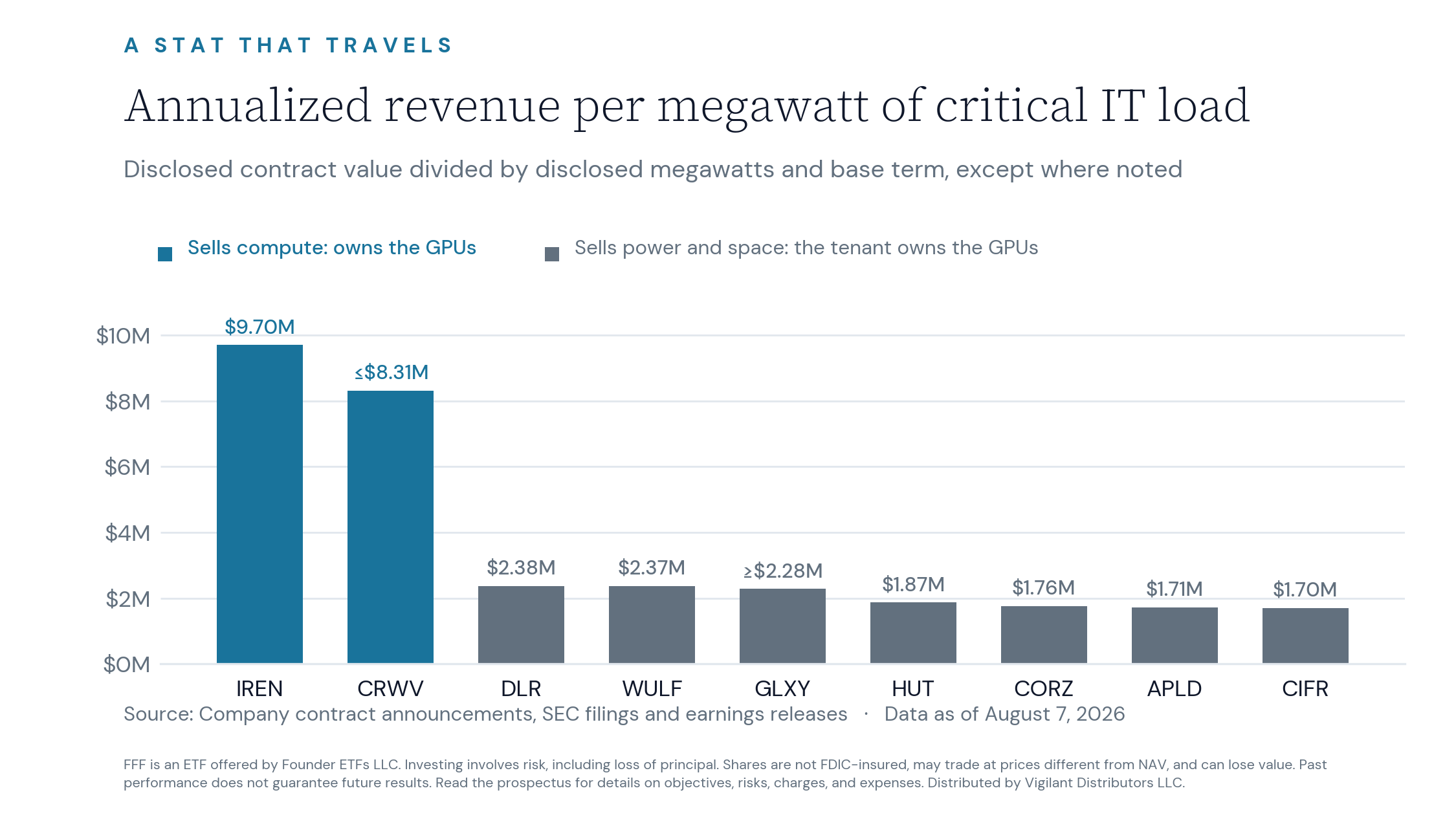
$9.7 million
What a megawatt earns depends on who owns the chips. IREN's AI cloud contract with Microsoft covers 200 megawatts of critical IT load for $9.7 billion over five years, which is $9.7 million of contracted revenue per megawatt per year. Colocation leases signed by the same class of company cluster between $1.70 and $2.38 million. The five-fold gap is a difference in what is being sold rather than a difference in how well a megawatt is run. IREN supplies the GPUs, servers and networking under its Microsoft contract, and signed a separate $5.8 billion equipment purchase agreement with Dell to source the hardware. The landlords supply power and shell, and their tenants bring their own hardware. The contract terms carry the same information. The GPU-inclusive deals run about five years. The colocation leases run 15 to 20. A chip that depreciates over five or six years gets amortized over a five-year contract; a concrete shell with power and cooling gets amortized over decades. The higher revenue per megawatt is compensation for owning the asset that goes obsolete. Two things the ranking hides. First, CoreWeave sits near the top at no more than $8.31 million, but most of the megawatts in that denominator are leased from three companies further down the same chart, so those megawatts are counted twice and part of the gap is rent CoreWeave pays to Core Scientific, Galaxy and Applied Digital. Second, the counterparties are narrower than nine separate contracts suggest. Fluidstack is the named tenant at Hut 8's River Bend, at Cipher's Barber Lake and at TeraWulf's Lake Mariner, with Google providing credit support in each case, and several other tenants are disclosed only as unnamed investment-grade companies. We think concentration of that kind belongs in any conversation about how contracted this revenue really is.
3forC: Three Talking Points for Clients
This week your clients will ask about: 1) why their statements look worse than the index, 2) Datadog, and 3) the jobs report. Let's dive in:
1) The Index Is Hiding the Tape
Through Friday, the S&P 500 ETF proxy (SPY) was up about 3.5% for the week and the Nasdaq-100 proxy (QQQ) about 5.0%. Underneath that, individual companies moved 10% to 30% in single sessions in both directions. On Thursday, August 6, the S&P 500 closed down 0.18% while several widely held growth names fell double digits. A client looking only at the index will not understand what happened to a specific position. Investors cannot invest directly in an index. Past performance does not guarantee future results.
2) Datadog
Datadog beat, raised full-year guidance, and fell 19.0%. The reason was disclosed on the call: its largest customer, which the company did not name, is reducing usage, and that reduction is built into the September-quarter and full-year outlook. Because Datadog charges largely by usage, a single large customer dialing back flows straight to revenue. Management said the customer renewed and that growth excluding that customer is holding. We flagged customer concentration as a risk in this position last week and we underweighted how quickly it could show up. Conviction Corner has the full accounting.
3) The Jobs Report
July payrolls fell 23,000 against expectations near +80,000, and the Bureau of Labor Statistics revised May and June down by a combined 103,000. The unemployment rate ticked down to 4.1%, and average hourly earnings rose 3.2% year over year. The direction this moves policy is worth noting: the market has been pricing a possible rate hike, not a cut. According to LSEG futures data cited by Reuters, the probability of a September hike fell from roughly 57% before the report to roughly 44% after it. A cut is still not the base case. In our view equities rose on the print because hike risk receded rather than because easing arrived.
Our forward-looking views reflect what we believe and may not be realized. Actual results may differ materially.
Industry Insight
The Bar
Three weeks ago the question was how much the hyperscalers were spending. Last week it was what that spending earned. We believe the market has now added a third test, on whether the next quarter shows the same thing. We also believe that test is not the whole explanation, and the honest version of this week includes where it fails.
Start with the cases that fit. Palantir grew revenue 93%, grew US commercial revenue 149%, closed a record $2.132 billion of US commercial total contract value, posted a Rule of 40 score of 155%, and raised full-year revenue guidance to $8.15 billion from $7.65 billion. Shares rose 29.5%. Shopify grew revenue 34% on gross merchandise volume of $115.6 billion, expanded operating margin by 276 basis points, and produced $654 million of free cash flow at an 18% margin. Shares rose 17.0%. On the other side, Datadog's September guidance implies deceleration to about 29% alongside a disclosed reduction from its largest customer, and the stock fell 19.0%. AppLovin missed revenue by roughly 1% and guided September margin down from 84% to 83% on higher compute costs; shares fell 19.7% to a 52-week low.
Now the cases that do not fit. Astera Labs guided September to $540 to $560 million, roughly 40% above the June quarter, which is a demanding guide by any standard, and fell 12.0%. AMD guided about 4% above consensus and fell 7.0%. Both had run hard into their reports, Astera Labs 45% over four sessions and AMD 20.7%, which points at positioning rather than guidance shape. SpaceX beat revenue by roughly $1 billion on 92% growth and fell 13.6%, on capital spending of $18.4 billion in a single quarter, a pace that annualizes near $74 billion against Street full-year expectations closer to $50 billion. And DoorDash grew revenue 36%, the same rate as Datadog, and rose 2.9%.
Our reading is that positioning did at least as much work as guidance shape, and in the Astera Labs and AMD cases probably more. What the week does not support is a single tidy rule. Nine companies over four sessions is a small sample, and we would rather say that than manufacture a pattern from it.
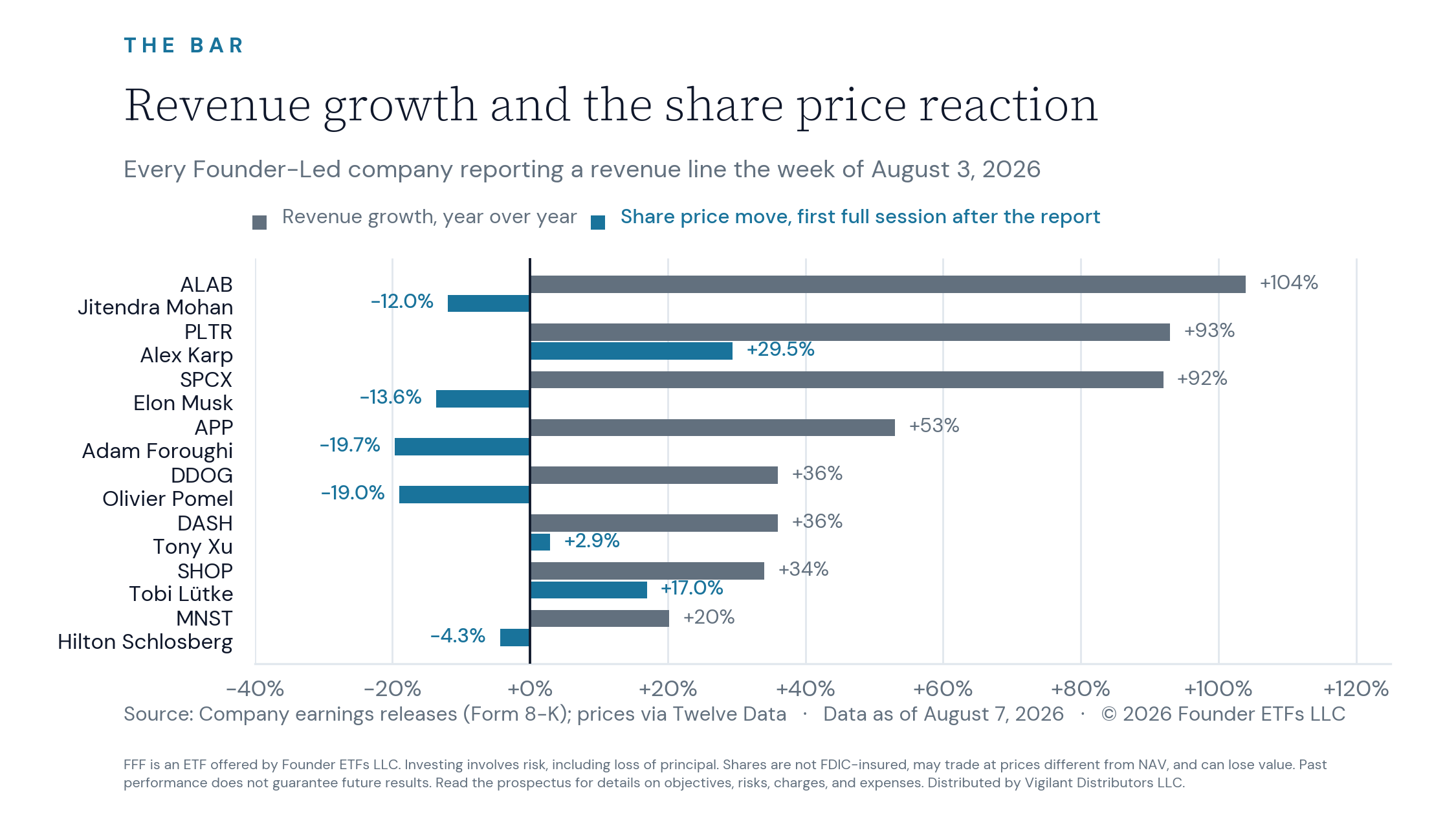
Source: revenue growth as reported by each company on SEC Form 8-K; share price move calculated from daily closing prices via Twelve Data. Data as of August 7, 2026. The share price move is the close-to-close change in the first full trading session after each release, which is the same session for companies reporting before the open. Past performance does not guarantee future results. Not a recommendation.
The financing side of the build moved at the same time. The $12.5 billion of debt BlackRock raised in late July for Meta's El Paso campus was issued through a special purpose vehicle in which BlackRock-backed entities hold 80% of the equity and Meta 20%, with maturities in 2048 backed by a twenty-year Meta lease beginning in 2028. The notes priced around 7.5%, roughly half a percentage point above what Meta paid on a comparable financing nine months earlier. The same structure, priced less than a year apart, now costs more.
Two of our Founders also moved toward each other last week. On August 4, SpaceX said on its official account that it is partnering with NVIDIA to design the Starmind AI1 satellite compute payload, which SpaceX states will carry NVIDIA Rubin GPUs and Vera CPUs. Elon Musk posted the same day that "SpaceX has committed to using Nvidia GPUs exclusively because they are the best," and told SpaceX's first earnings call as a public company that he expects to begin launching the hardware next year. That is a change from the chip-vendor-agnostic language SpaceX had used for the program previously. This week Jensen Huang shared Musk's post publicly, adding the line "AI at the final frontier."
Two chief executives endorsing an arrangement on social media is not the same as disclosing one. Neither company has released commercial terms, dollar figures, volumes or purchase commitments. NVIDIA has issued no press release or SEC filing describing the scope of its participation, and neither company has tied the program to guidance or revenue. NVIDIA's next earnings call is August 26, which is the first scheduled opportunity for the company itself to characterize this.
The sharpest caution on record also comes from Huang. On NVIDIA's February earnings call he said the economics of orbital data centers "are poor today, but it is going to improve over time," and named three constraints: cooling, because there is "no airflow in space" and heat can only be shed by conduction through radiators; the cost of launch and of repairs once a satellite is up; and the difficulty of converting orbital solar power into stable, radiation-shielded power for GPUs. A payload that cannot be serviced after launch also sits awkwardly against a GPU generation cycle of roughly two years. Six months separate "the economics are poor today" from "AI at the final frontier," and nothing published in between explains what changed.
The program is speculative and we are not treating it as a thesis. The structural point is what interests us: two Founder-Led companies, one making the chips and one owning the launch capacity, are designing hardware together around the constraint that governs the entire AI build, which is power and the heat that comes with it. Founder control is what lets two companies commit engineering resources to something this early and this uncertain. The same control means fewer internal checks if the economics do not work, which is the governance risk we name in every issue.
We own Founders across the chain and we intend to keep doing so. On the building side we hold Meta, NVIDIA, CoreWeave and SpaceX; on the earning side, Palantir, Shopify, Fortinet and Bloom Energy. Both groups will have quarters like the ones above. We reconstitute quarterly on fresh fundamental data through earnings season, and we would rather hold a Founder through a repricing than guess which week the market changes its test.
Portfolio Pulse
Founders in Their Own Words
From Monster Beverage's second-quarter results, August 6, 2026
“Our international operations continued their meaningful contribution to revenue growth, with net sales to customers outside the United States increasing 34.6 percent in the 2026 second quarter to approximately 46 percent of total net sales.”
Our take. Monster is the reminder that this week's pattern was not confined to AI. Net sales grew 20.2%, above consensus, and adjusted earnings beat, and the stock still fell 4.3%. The reason sits in the mix: case sales rose 22.3% while average net sales per case fell 1.1%, so the growth came from volume rather than price, and operating expenses rose faster than gross margin improved. International is now about 46% of sales, up from roughly 41%. Co-CEO Schlosberg's company is growing by selling more cans in more countries. We believe that is a durable engine, and it is also a lower-margin one than pricing power would be.
Conviction Corner
RIA Q&A on FFF's Role in a Portfolio
Q. You featured Datadog in last week's Spotlight at a $300 estimate of value, three days before it reported. It fell 19.0%. What happened, and does the work still hold?
A. Here is the accounting, starting with the outcome.
Datadog closed at $283.17 on August 5 and $229.29 on August 6, a decline of 19.0% in one session. Our published estimate of value was $300. The stock is roughly 24% below that number. FFF held Datadog when we published and holds it now. Past performance does not guarantee future results.
What we underweighted: speed and size. We named customer concentration as a risk and wrote that a pullback from the largest AI customer would be "a real near-term hit." We framed it as something to monitor over quarters. It arrived in the next print. The reaction was also larger than a 4% to 6% revenue exposure alone would explain, because the market repriced the growth rate rather than subtracting a customer. Our $300 estimate assumed a multiple that a decelerating growth rate does not support.
What we are doing: we are withdrawing the $300 estimate rather than leaving it standing, and we will publish revised work in a future issue. We have not traded the position on this print. Its weight is set at our quarterly reconstitution on fundamental data, and the next one is the point at which this quarter's numbers affect it.
What has not changed: revenue grew 36%, customers with at least $100,000 in annual recurring revenue rose 23% to about 4,720, an acceleration from 21% in the prior quarter, and the company raised full-year guidance on all three lines it guides. Management said growth excluding the largest customer is holding.
We also want to be clear about what we did get right, because we think you should hold us to both. We named the risk that materialized and we wrote that at roughly 21x forward sales the stock had no cushion for a lowered forecast. Naming a risk is not the same as sizing it correctly, and we sized it too small.
Concentration risk, key-person risk, growth-style volatility and single-stock volatility all apply. Our forward-looking views reflect our opinion and may not be realized.
Macro Minutes
U.S. Economic Releases · Week of Aug 10 - 15
What We're Watching
The Labor Data Cracked
July payrolls fell 23,000 against a consensus near +80,000, and the Bureau of Labor Statistics revised May down by 66,000 and June down by 37,000, putting the two months a combined 103,000 lower than previously reported. Local government education lost 50,000 jobs, retail 19,000 and financial activities 14,000; health care added 22,000. The household survey pointed the other way, with unemployment falling to 4.1% and participation easing to 61.4%. Average hourly earnings rose 3.2% year over year. The rest of the week's data did not settle it. ISM manufacturing rose to 55.6%, its highest since May 2022, with its employment index expanding for the first time in 33 months. ISM services edged up to 54.1% from 54.0%, while its employment index fell to 47.4%, back into contraction. Both ISM prices indexes printed above 70. Second-quarter productivity rose 1.4% annualized with unit labor costs up 1.3%. Weekly jobless claims were 199,000, near the cycle low. Rates moved less than the headlines suggest. The 10-year Treasury touched 4.75% on July 31 before easing to 4.69% by August 6; the 2-year went from 4.28% to 4.25%. Brent crude fell from roughly $92 at the end of July to about $82 as the United States, Iran and Oman moved toward an interim arrangement on the Strait of Hormuz, including a proposed 60-day trial with no transit fees. Roughly eight vessels transited the Strait on a recent day, against more than 100 a day before the conflict.
Our take. Three regional Fed presidents dissented for a hike on July 29, and Neel Kashkari repeated the case publicly on August 5, two days before the payroll number. Then the payroll number went negative. A committee that was arguing about whether policy is restrictive enough now has to weigh whether it is already too restrictive, using data that disagrees with itself: negative payrolls alongside a falling unemployment rate, expanding manufacturing employment alongside contracting services employment, and price indexes above 70 in both surveys. We believe the September decision is now genuinely open, and we would treat confident forecasts in either direction with suspicion. In our view the falling oil price matters more here than the payroll number, because it removes the energy impulse that had been supporting the hawkish case. If the Hormuz arrangement holds and crude stays near $80, we believe the case for a hike weakens. If it breaks, the argument resets. We position by process rather than by prediction.
Earnings Edge
FFF Holdings Reporting
Alex Karp, CEO
reported August 3
Revenue of $1.935 billion grew 93% year over year and 19% sequentially, above consensus near $1.81 billion, with adjusted earnings per share of $0.41 against $0.35 expected. US commercial revenue grew 149% to $764 million and US government revenue grew 90% to $809 million. The company closed $3.373 billion of total contract value, including a record $2.132 billion in US commercial, and reported 73 deals of at least $10 million. Rule of 40 was 155%, and adjusted free cash flow was $1.220 billion at a 63% margin. Palantir raised full-year revenue guidance to $8.150 to $8.158 billion from $7.650 to $7.662 billion and raised adjusted free cash flow guidance to $4.5 to $4.7 billion. Shares rose 29.5%.
Elon Musk, CEO
reported August 4
The first quarterly report since June's IPO. Revenue of $7.8 billion grew 92% year over year and came in roughly $1 billion above consensus. Net loss was $541 million, or $(0.09) per share, narrowed from about $1 billion a year earlier, and adjusted EBITDA nearly tripled to $3.5 billion. Starlink revenue was $4.29 billion, up 66%, with about 12 million subscribers. The AI segment grew 247% to $2.6 billion on $14.1 billion of new cloud contracts and carried a $1.26 billion operating loss. Capital expenditures of $18.4 billion in the quarter annualize to roughly $74 billion, against Street full-year expectations closer to $50 billion. Shares closed down 13.6% the following session. The insider lockup expired on August 6, releasing roughly 911.5 million shares, and the stock rose 6.1% that day.
Jitendra Mohan, CEO
reported August 4
Revenue of $392.4 million grew 104% year over year and 27% sequentially against an estimate near $360.8 million, with non-GAAP earnings per share of $0.80 versus $0.69 expected. Scorpio fabric switches became the largest product family a quarter earlier than the company had expected, and PCIe 6 products exceeded half of revenue, up from about a third in the prior quarter. September guidance of $540 to $560 million implies roughly 40% sequential growth, with non-GAAP gross margin guided to about 72% against 73.7% delivered, reflecting a mix shift toward switches. Shares fell 12.0% after rising 45% in the four sessions into the report.
Marc Rowan, CEO
reported August 4
Fee Related Earnings of $785 million rose 25% year over year and Spread Related Earnings of $877 million rose 6.8%, both company records. Adjusted Net Income was $1.314 billion, or $2.11 per share. Total assets under management reached $1.047 trillion with fee-generating AUM of $858 billion. Inflows were $60 billion in the quarter and $298 billion over the trailing twelve months, and origination was $74 billion. Shares rose 2.9% on the day and have since given back that gain. Apollo's year-to-date GAAP figures are distorted by a one-time $1.7 billion tax expense recorded in the first quarter, so trailing GAAP comparisons are not meaningful for this name at present.
Tobi Lütke, CEO
reported August 5
Revenue of $3.583 billion grew 34%, above an estimate near $3.46 billion, on gross merchandise volume of $115.567 billion, up 32%. Operating income was $488 million at a 13.6% margin, 276 basis points better than a year ago, and free cash flow was $654 million at an 18% margin against 16%. Reported GAAP earnings per share of $1.16 include roughly $1.063 billion of after-tax mark-to-market gains on equity investments and are not comparable to consensus. September guidance calls for revenue growth in the low thirties percent and free cash flow margin in the high teens to low twenties. Shares rose 17.0%.
Adam Foroughi, CEO
reported August 5
Revenue of $1.924 billion grew 53% but came in roughly 1% below consensus near $1.94 billion, and adjusted EBITDA of $1.614 billion at an 84% margin was about 1.5% light. GAAP diluted earnings per share of $3.76 was in line. September guidance of $2.055 to $2.085 billion sits at or slightly below the Street, with EBITDA margin guided to 83%. Free cash flow was $863.3 million, and the company repurchased $551.3 million of stock, down from about $1 billion in the prior quarter. On the call, Founder Adam Foroughi attributed the shortfall to the timing of model improvements rather than advertiser demand. Shares fell 19.7% to a 52-week low.
Tony Xu
reported August 5
Revenue of $4.454 billion grew 36%, above an estimate near $4.34 billion, on total orders of 970 million, up 27%, and marketplace gross order value of $33.1 billion, up 36%. Excluding the Deliveroo acquisition, orders grew 17% and gross order value 23%. Adjusted EBITDA of $914 million rose 40% and free cash flow of $742 million more than doubled. GAAP earnings per share of $0.46 fell 29% year over year on acquisition accounting and roughly $1.2 to $1.3 billion of annual stock-based compensation, so adjusted EBITDA and free cash flow are the operative measures. Shares rose 2.9%.
Olivier Pomel, CEO
reported August 6
Revenue of $1.1215 billion grew 36%, above both consensus near $1.08 billion and the company's own guidance, with non-GAAP earnings per share of $0.65 against $0.58 expected. Customers with at least $100,000 in annual recurring revenue reached approximately 4,720, up 23%, an acceleration from 21% in the prior quarter. Datadog raised full-year guidance to revenue of $4.45 to $4.47 billion from $4.30 to $4.34 billion, non-GAAP operating income to $1.01 to $1.03 billion, and non-GAAP earnings per share to $2.50 to $2.54. September guidance of $1.135 to $1.145 billion implies growth slowing to roughly 29%. Management disclosed that its largest customer is reducing usage and that the reduction is reflected in guidance. GAAP operating income was $5 million against $257 million on a non-GAAP basis. Shares fell 19.0%.
Hilton Schlosberg, CEO
reported August 6
Net sales of $2.537 billion rose 20.2%, or 17.9% excluding currency, above an estimate near $2.43 billion, with adjusted earnings per share of $0.60 against $0.58 expected. Case sales rose 22.3% to 304.9 million while average net sales per case fell 1.1% to $8.20, so the quarter was carried by volume. International net sales rose 34.6% to $1.16 billion and now represent about 46% of the total. Gross margin improved 23 basis points to 55.9% while operating expenses rose 100 basis points as a share of sales, so operating margin declined year over year. No shares were repurchased in the quarter, with $900 million remaining under authorization. Shares fell 4.3%.
Monday, August 10
monday.com (MNDY), Roy Mann and Eran Zinman; Rocket Lab (RKLB), Peter Beck; AST SpaceMobile (ASTS), Abel Avellan; Hims & Hers (HIMS), Andrew Dudum
Tuesday, August 11
CoreWeave (CRWV), Michael Intrator; Sea Limited (SE), Forrest Li; Super Micro (SMCI), Charles Liang; CAVA (CAVA), Brett Schulman
Wednesday, August 12
Nebius (NBIS), Arkady Volozh; Global-e (GLBE), Amir Schlachet
Thursday, August 13
Nu Holdings (NU), David Vélez
Washington Wire
“Now is the time to start slowly moving up as we get more data in.”
Minneapolis Fed President Neel Kashkari, on the case for raising rates, August 5, 2026
Our take. Kashkari said this on Wednesday. On Friday, payrolls came in at negative 23,000 with 103,000 of downward revisions to the prior two months. He was one of three regional presidents who dissented for a hike on July 29 and he has been consistent about why, so this is not a criticism of his reasoning. It shows how quickly the ground moves under a committee that has stepped back from forward guidance. Chair Warsh has run these meetings with shorter statements and less signaling than his predecessors. The cost is that one data release can reset the debate; the benefit is that nobody has to walk back a promise. The minutes of the July 28 to 29 meeting are released Wednesday, August 19, and should show how close the vote actually was.
Investing involves risk, including possible loss of principal, high volatility from Founder-Led stock concentration, growth-style investing, Software exposure, and key-person risk (the risk a Founder leaves). Carefully consider the Fund's investment objectives, risks, charges, and expenses before investing by reading the prospectus at http://FounderETFs.com/FFF.
FFF is the Founders 100 ETF, an actively managed fund with a 0.75% net expense ratio that invests primarily (at least 90%) in Founder-Led, US-listed common stocks or REITs selected via proprietary criteria, with no assurance of achieving its capital appreciation objective. Shares trade at market price, which may be at a premium or discount to NAV, are redeemable only in Creation Units of 10,000 shares, and are not insured or guaranteed by any agency, including FDIC or FRB. ETFs may trigger capital gains; consult your tax and investment advisors.
Past performance does not guarantee future results. Bain & Company charts show historical indexed total shareholder return of S&P 500 Index stocks (Founder-Led vs. non-founder-led, 1990 to 2014 and 2015 to 2024), are illustrative only, and do not represent FFF performance (first traded 12/18/25, limited history). Founder ETFs is not affiliated with or endorsed by Bain. Founder ETFs defines "Founder-Led" as a firm with an original Founder serving as a chief officer; Bain's definition also includes Founder board members.
Not investment advice or a solicitation to buy or sell any security. All data including portfolio weights, sector weights, and one-month price moves referenced in this issue are as of 7/17/26, subject to change without notice, and are not recommendations. References to prior technology investment cycles and historical infrastructure build-outs are illustrative and do not predict future results; estimates of future AI infrastructure investment reflect the Adviser's opinion. Company financial figures are sourced from SEC filings; the APR Energy transaction value is an estimate reported in the press and was not officially disclosed. References to litigation involving xAI reflect allegations that are unproven and contested. Earnings dates are company-announced and subject to change. This communication may contain forward-looking statements based on current expectations and assumptions and actual results. These statements are subject to risks and uncertainties, and actual results may differ materially from those anticipated. We undertake no obligation to update these statements as a result of new information or future events. Concentration in Founder-Led companies does not guarantee superior performance and may introduce additional risks, including governance risk (a Founder making a poor strategic decision) and concentration risk. Distributed by Vigilant Distributors LLC.
Founder Factor · Weekly Newsletter