The Payoff
Big Tech earnings week turned into a referendum on AI returns, not just capex. Microsoft and Meta had different answers, leading the stocks to rise and fall, respectively. Inside: why we own Founders on both sides of that line, the setup into Datadog's report this week, last week's Founder-Led scoreboard, and our thoughts on META, our largest holding.
Opening Bell
Welcome! At Founder ETFs, we help RIAs close the Founder Gap hiding in their clients' portfolios.
According to Bain & Company, Founder-Led companies in the S&P 500 generated total shareholder returns (TSR) 3.1x those of non-founder-led peers from 1990 to 2014, and 2.1x from 2015 to 2024. Past performance does not guarantee future results. Yet our research shows the 300 largest US equity ETFs (90% category AUM) own just 12.55% Founders. We built the Founders 100 ETF (100% Founders) to help close that gap.
Michael and I aren't a faceless asset manager. When you call, email, or text, you get us.
We're your partners: sharing our fundamental research, our highest-conviction Founder ideas, and following our disciplined, 80%+ rules-based process designed to help remove emotional decision making during periods of fear and greed. As two of the largest $FFF shareholders, we plan to be fully invested alongside you for the next 30 years. Your success is our success.
The loudest story in markets last week was the bill for artificial intelligence. The four largest cloud builders are on track to spend an estimated $725 billion on capital projects this year, most of it for AI — the sum of the four companies' own 2026 capital-spending guidance (Amazon ~$220B, Microsoft ~$190B, Alphabet ~$175–185B, Meta $130–145B) — and reporting season put that number on trial. Microsoft crossed $100 billion in annual Azure revenue and its shares rose. Meta, our largest holding, grew revenue 28% but watched free cash flow fall to $784 million as its own capital spending climbed, and its shares fell roughly 9%. Two companies, the same spending wave, opposite verdicts. The dividing line was evidence that the spending is turning into revenue.
We are not going to dress up a hard day for our biggest position. Meta dropped on this print, and we flagged the risk a week ago. What we would ask you to hold onto is the shape of the whole portfolio: FFF owns Founders across the AI chain, from the companies still spending to build it to the ones already earning on it. Later this week one of the clearest examples of the second group, Olivier Pomel's Datadog, steps up to report. We don't chase the tape. FFF reconstitutes quarterly on fresh fundamental data through earnings season, and we watch our 100 Founders report one by one.
We are here to answer your questions. Welcome to Issue #12.
Michael & Lauren
Founder Spotlight
Olivier Pomel at Datadog
Co-Founder & CEO · Datadog, Inc. (DDOG) · Reports Thursday, August 6
Olivier Pomel and Alexis Le-Quoc co-founded Datadog in 2010 after watching developers (who write software) and operations teams (who keep software running) argue over different aspects of the same systems. Datadog is like a fitness tracker for software, constantly monitoring the health, speed, latency, and error rates of every app and AI agent a company runs so engineers can see what their software is doing, especially as more of that software is written and run by machines.
We estimate that Datadog is worth $300/share, ~21x 2027E sales (~$5.2 billion), a premium to other monitoring companies but reasonable for a business growing revenue >20% YoY while turning ~27 cents of every $1 in sales into free cash flow (FCF). That is equivalent to ~94x 2027E adjusted EPS of $3.20 (above the $2.97 estimate), a steep price tag but a defensible one for one of the clearest winners from the AI boom.
Datadog sells three tiers of products. Its original suite watches the underlying servers and machines. The second suite includes APM (Application Performance Monitoring), which watches how apps perform, and Logs, which collects software records; together, the second suite now makes up half of Datadog's recurring revenue and is growing faster than the original suite. The third suite includes products like Bits, AI Guard, Agent Console, and LLM Observability, which watch AI agents directly. As AI agents write more code, they produce systems no person fully understands, which makes monitoring more essential. Most Datadog customers still use only one or two of these three product lines, and when a customer uses more of them, it spends meaningfully more. Datadog has a long runway of growth just from cross-selling its newer products to existing customers, without adding a single new one.
Over the next five years, Datadog has the opportunity to go after more of its $60 billion total addressable market (TAM). A fast-growing base of AI-first customers (ex-OpenAI, Datadog is already achieving sales >$100 million/year) and corporate AI spending that is only in its early innings give it a long runway ahead. We also see the market settling into a cooperative duopoly: Datadog owns the developer-driven, pay-as-you-go, AI-native end while Dynatrace owns the locked-in-contract, premium enterprise end. The two divide the market more than they steal from each other, and both are growing sales >20% YoY with sensible pricing.
Price Target
$300
Target Multiple
~21x 2027E sales (~94x 2027E adj. EPS)
Q1 2026 Revenue Growth
+32% YoY
Free Cash Flow Margin
~27% of sales
Total Addressable Market
~$60 billion
OpenAI Concentration
~4–6% of revenue
Risks We're Watching
Valuation is the first and largest risk: at ~21x next year's sales and ~94x next year's earnings, the stock is priced for perfection, so any lowered forecast leaves no cushion and a shrinking multiple is the most likely way to lose money here. Competition is the second, from AI-monitoring startups such as Arize and Helicone and from the big cloud providers' own in-house tools. Customer concentration is a third: OpenAI is an estimated ~4–6% of revenue, and if it were to build monitoring in-house that would be a real near-term hit, though a fast-growing base of other AI customers would likely backfill it in 2027. Finally, because Datadog charges largely by usage, any move by companies to rein in runaway AI ("token") spending flows straight through to its sales.
A Stat That Travels
$848 billion
Three years of build-out. That is what the four hyperscalers, Amazon, Microsoft, Alphabet, and Meta, have spent on capital projects over the last twelve quarters, from the middle of 2023 through the first quarter of 2026. Amazon has carried the largest share, but all four are climbing together. Their combined quarterly spending has nearly quadrupled, from about $34 billion to $130 billion, with the majority of the spend going to data centers. The market wants to see this spending translate into sales and higher earnings, not just depreciation.
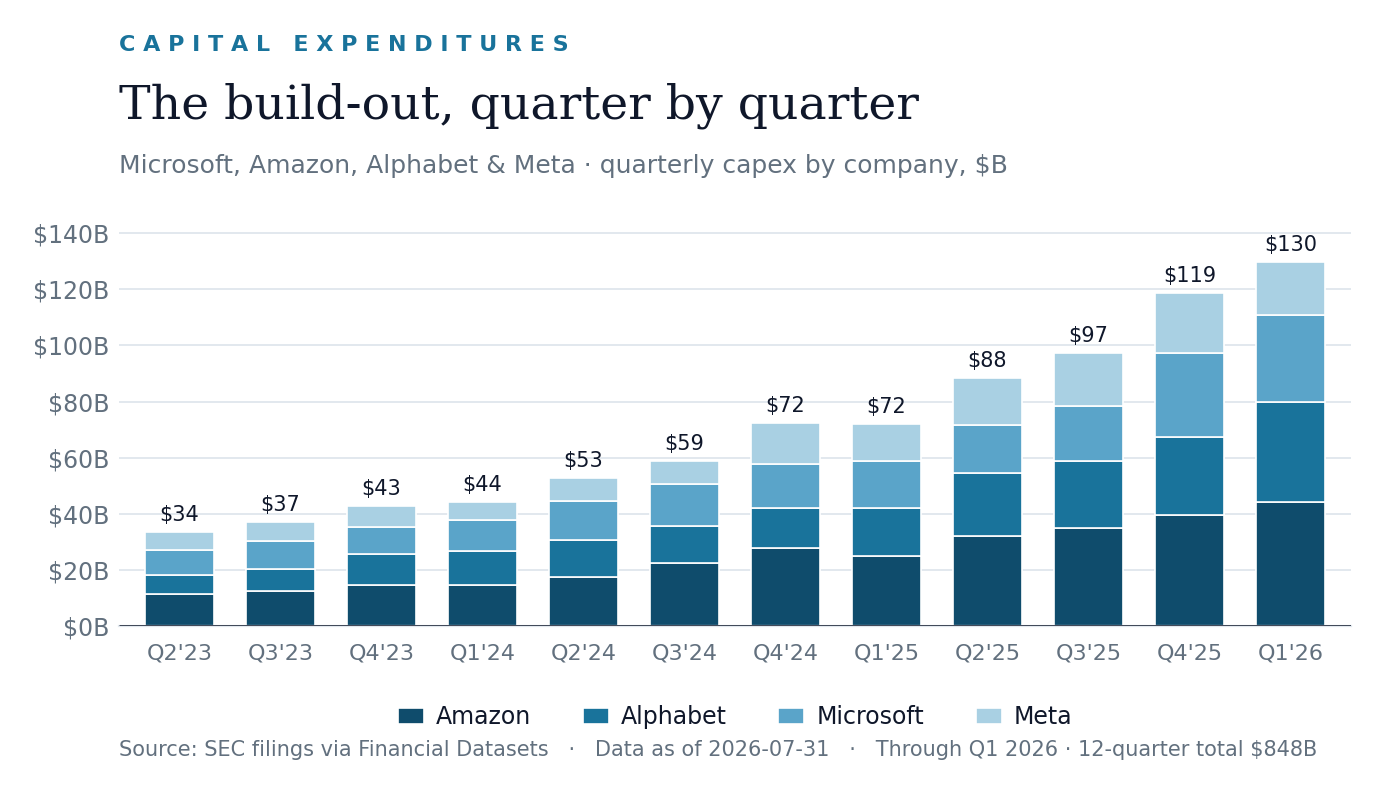
Source: Source: SEC filings via Financial Datasets, as of July 31, 2026. Each bar is the four companies' quarterly capital expenditures, stacked by company, Q2 2023 through Q1 2026 (the latest quarter filed by all four); the twelve quarters sum to about $848 billion (Amazon $298B, Alphabet $206B, Microsoft $198B, Meta $146B). Not a recommendation.
3forC: Three Talking Points for Clients
This week your clients will ask about: 1) Meta's drop, 2) whether Big Tech is overspending on AI, and 3) the Fed. Let's dive in:
1) Meta's Drop
Meta is our largest holding and it fell about 9% after reporting. The company reported a disappointing Q2 with a small sales beat (+1%) and a sizeable EPS miss (−14%, diluted EPS of $6.18 versus a $7.18 estimate). Sales grew +28% to $61B, with 3.6B people using at least one Meta app every day. Q3 sales guidance, with a $62.5B midpoint, fell slightly below the $63B expectation. META raised the low end of its FY capex guidance by $5B to a range of $130–145B, with no clarity on the size or timing of the return, though the narrowing signals confidence in the spending. FCF was under $1B, the lowest in a year, though Founder Mark Zuckerberg said that "AI is accelerating our core business today" and that he believes "[AI] is going to be a big thing." Reality Labs (Metaverse) lost $4.6B, maintaining the quarterly trend. META took a $2.4B legal charge, likely tied to youth-safety litigation; we'll know more once the 10-Q is filed. Meta also took a $1.2B severance charge from the May layoff of 8,000 employees (~10% of the workforce) and issued $25B in new debt. Having a Founder at the helm means Meta can keep investing and pivot quickly if returns fail to materialize.
2) Are We Overspending on AI?
While the spending is large and accelerating, the market has started separating the companies showing a return from the ones still promising one. Microsoft, with Azure sales >$100 billion, and Amazon, where cloud sales growth accelerated to 37% even as the firm guided to $220 billion of capex, were both rewarded, while Meta was not. We own Founders across various stages of the investment cycle and let the fundamentals, rather than the narrative, sentiment, or momentum, determine our selection.
3) The Fed
The Federal Reserve held its policy rate at 3.50% to 3.75% on July 29, the fifth consecutive meeting without a change. What was new was the split: three regional Fed presidents dissented in favor of a +0.25% hike. June's PCE inflation, released just after the meeting, eased to 3.7% headline and 3.3% core, though core has now held at or above 3.3% for four months. With oil still hovering near $90/barrel and the Iran conflict unresolved, the risk of a rate hike at the September meeting has risen substantially.
Our forward-looking views are what we believe, not what's guaranteed. Results can and will surprise.
Industry Insight
The Payoff
The market's reaction to Big Tech's Q2 reports showed the shift from AI spending to returns in real time. The four largest cloud builders, Microsoft, Amazon, Alphabet, and Meta, are on track to spend an estimated ~$725 billion on capex in 2026, +77% year-on-year and nearly 2x the prior record, based on the four companies' combined full-year capital-spending guidance. Early in the buildout, investors rewarded the ambition. Now they are rewarding the results.
Microsoft reported that Azure exceeded $100 billion in annual sales, growing in the low 40s percent, and the stock rose +8%. Amazon spent even more, yet its shares jumped double digits, because Amazon Web Services (AWS) growth accelerated to +37% year-on-year, its fastest in five years. Meta reported +28% YoY sales growth but a collapse in free cash flow (FCF) to under $1 billion, and its shares fell 9%. On the same evening, memory maker SK Hynix posted a record operating profit, up more than 550% YoY, but short of expectations, resulting in a −10% drop. Spending was welcomed where the market could see it turning into sales.
This week, BlackRock raised $12.5 billion of investment-grade debt to fund a one-gigawatt AI data-center campus for Meta in El Paso, Texas. BlackRock-backed entities hold most of the project's equity and Meta a minority, with the debt serviced by Meta's lease commitments, an arrangement that keeps the obligation off Meta's own balance sheet while giving Meta the compute it needs. The build-out is now being financed with structured, off-balance-sheet capital as well as corporate cash, which is one reason the spending can keep growing even as free cash flow tightens. The offering was significantly oversubscribed, and institutional money continues to flow into private-market and infrastructure financing.
We own Founders across the AI value chain. On the building side we hold Meta, spending through the cycle, and Nvidia, whose chips sell regardless of which cloud wins. On the earning side we hold the companies already converting AI into revenue and cash, from Palantir in software to Bloom Energy in on-site power to Fortinet in security. We would rather own the Founders across the AI ecosystem than try to guess which niche the market will favor next. In Founder hands, wise investments today can become tomorrow's higher earnings.
Portfolio Pulse
Founders in Their Own Words
KR Sridhar, on Bloom Energy's second-quarter results, July 28, 2026
“Bloom is now a standard for AI onsite power.”
Our take. Bloom's Founder has spent two decades building fuel-cell technology. In Q2 Bloom reported sales of $1.07 billion, up 166% year over year, adjusted EPS of $0.78 (well above the $0.41 estimate), and raised its FY26 sales and EPS guidance. Founder Sridhar generates sales as our other Founders spend more.
Conviction Corner
RIA Q&A on FFF's Role in a Portfolio
Q. Meta is your largest holding and it just fell about 9% on earnings. Is the thesis broken?
A. No; while a disappointing quarter, the long-term thesis is intact. First, Q2 capex was ~$31 billion, but heavy investment today can become significant free cash flow in future quarters. Second, Founder control is a large part of why Meta invests for the long term, not for the quarter. We trust Mark's vision.
Macro Minutes
U.S. Economic Releases · Week of Aug. 3 - 7
What We're Watching
The Federal Reserve held rates steady on July 29, and the meeting produced its first real split under Chair Kevin Warsh: three regional Fed presidents dissented in favor of a quarter-point increase. June PCE inflation, released just after the decision, eased to 3.7% at the headline and 3.3% at the core, but core has now printed at or above 3.3% for four straight months, the longest such stretch in nearly three years. Brent crude sat near $90 as an uneasy pause in the Iran conflict held without a settlement, keeping energy a live risk to inflation. Markets now price effectively no chance of a near-term cut and a real, if minority, chance of a hike, and the 10-year Treasury yield backed up toward 4.70% as Big Tech earnings revived the AI trade into late July.
Our take. This is a Fed being pulled in two directions at once. Disinflation is real but grinding, so the doves can point to a core rate drifting lower. At the same time, energy prices are rebounding, so inflation hawks can point to the rising risk of higher rates. A divided committee that keeps expectations anchored is a healthier outcome than false certainty in either direction. We position by process rather than by prediction. We believe a lasting peace agreement with Iran would quickly give the Fed room to cut rates by year end, likely a winning scenario for US growth stocks, led by Tech. If the conflict persists, oil prices may move structurally higher, making rate hikes more likely to contain inflation.
Earnings Edge
FFF Holdings Reporting
Dr. KR Sridhar, CEO
reported July 28
BE reported a beat-and-raise quarter, including Q2 sales of $1.1B (a +27% beat) and adjusted earnings per share of $0.78 (a +94%, or +38-cent, beat). Bloom raised FY26 guidance: sales +31% at the midpoint to a new range of $3.9–4.2B, and adjusted EPS +32% at the midpoint to a new range of $2.55–$2.85. BE delivered on our forecast for record sales and earnings.
Ken Xie, CEO
reported July 29
FTNT reported a beat-and-raise quarter, including Q2 sales of $2.1B (a +9% beat) and adjusted EPS of $0.90 (a +20%, or +15-cent, beat). Product sales grew +52% and billings +33%. Ken Xie's company raised its FY26 sales outlook to $8.02–8.18B and guided Q3 sales of $2.0–$2.1B. Billings and the shift toward its combined networking-and-security offering, the two areas we said we were watching, both came in ahead.
Vlad Tenev, CEO
reported July 29
HOOD reported a good quarter, including sales of $1.31B (a +2% beat) and adjusted EPS of $0.62 (a +39%, or +18-cent, beat, though ~$0.14 of the beat came from the deconsolidation of Robinhood Ventures Fund I). Net deposits were $21.7 billion and Gold subscribers reached 4.8 million. Crypto was the soft spot we flagged, but growth elsewhere more than offset the ongoing weakness.
Yaki Faitelson, CEO
reported July 28
Revenue of $180.0 million grew 18% against a $176.8 million estimate, with non-GAAP earnings per share of $0.04 versus $0.01 expected, and SaaS annual recurring revenue reached $726.0 million, up 52%. Co-Founder Yaki Faitelson raised full-year revenue and profit guidance and pointed to organizations prioritizing data and AI security, a read that rhymes with Fortinet's.
Sanj K. Patel
reported July 28
Revenue of $243.6 million rose 55% against a $226.5 million estimate, with diluted earnings per share of $0.30, in line. Founder Sanj K. Patel's company raised full-year net product revenue guidance for its lead therapy ARCALYST to $980 to $995 million, a Health Care counterweight to a tech-heavy week.
Steve Huffman, CEO
reported July 30
Revenue rose 61% to $805 million, an eighth straight quarter above 60% growth, with advertising up 64% to $762 million and net income of $253 million, more than double a year ago. The market looked past the beat: US daily active users slipped from the prior quarter as automated search results, including Google's AI Overviews, pressured logged-out traffic, and the shares fell more than 20% on the day. Steve Huffman's point was that as the internet automates, the value of authentic human conversation rises. We own Reddit for that community moat, and this quarter put both the advertising momentum and the AI-driven traffic risk in the same report.
Michael Hsing, CEO
reported July 30
Record revenue of $981M rose +48% year over year and beat an estimate near $920 million, with earnings of $6.50 against $5.98 expected. Enterprise-data revenue, the piece tied to AI servers, grew about 164% year over year to $380.6 million. Michael Hsing's company guided third-quarter revenue to $1.14 to $1.16 billion and added $500 million to its buyback. These power-management chips sit right alongside the AI accelerators this issue is about, and the shares rose about 10%.
Dr. Alex Karp, CEO
Monday, August 3
Marc Rowan, CEO
Tuesday, August 4
Jitendra Mohan, CEO
Tuesday, August 4
Tobi Lütke, CEO
Wednesday, August 5
Adam Foroughi, CEO
Wednesday, August 5
Tony Xu, CEO
Wednesday, August 5
Olivier Pomel, CEO
Thursday, August 6
Hilton Schlosberg, CEO
Friday, August 7
Washington Wire
“I asked for a good family fight, and I got one.”
Fed Chair Kevin Warsh, on the July FOMC meeting, July 29, 2026
Our take. Warsh has run his first meetings differently from his predecessors, with shorter statements and less forward guidance. Last week he got the open disagreement he said he wanted: three regional presidents dissenting for a hike while the majority voted to hold rates steady. A committee that argues in the open and publishes the split is credible, exactly what markets need while energy keeps upward pressure on inflation from the unresolved Iran conflict. Politics aside, we are encouraged by the disagreement.
Investing involves risk, including possible loss of principal, high volatility from Founder-Led stock concentration, growth-style investing, Software exposure, and key-person risk (the risk a Founder leaves). Carefully consider the Fund's investment objectives, risks, charges, and expenses before investing by reading the prospectus at http://FounderETFs.com/FFF.
FFF is the Founders 100 ETF, an actively managed fund with a 0.75% net expense ratio that invests primarily (at least 90%) in Founder-Led, US-listed common stocks or REITs selected via proprietary criteria, with no assurance of achieving its capital appreciation objective. Shares trade at market price, which may be at a premium or discount to NAV, are redeemable only in Creation Units of 10,000 shares, and are not insured or guaranteed by any agency, including FDIC or FRB. ETFs may trigger capital gains; consult your tax and investment advisors.
Past performance does not guarantee future results. Bain & Company charts show historical indexed total shareholder return of S&P 500 Index stocks (Founder-Led vs. non-founder-led, 1990 to 2014 and 2015 to 2024), are illustrative only, and do not represent FFF performance (first traded 12/18/25, limited history). Founder ETFs is not affiliated with or endorsed by Bain. Founder ETFs defines "Founder-Led" as a firm with an original Founder serving as a chief officer; Bain's definition also includes Founder board members.
Not investment advice or a solicitation to buy or sell any security. All data including portfolio weights, sector weights, and one-month price moves referenced in this issue are as of 7/17/26, subject to change without notice, and are not recommendations. References to prior technology investment cycles and historical infrastructure build-outs are illustrative and do not predict future results; estimates of future AI infrastructure investment reflect the Adviser's opinion. Company financial figures are sourced from SEC filings; the APR Energy transaction value is an estimate reported in the press and was not officially disclosed. References to litigation involving xAI reflect allegations that are unproven and contested. Earnings dates are company-announced and subject to change. This communication may contain forward-looking statements based on current expectations and assumptions and actual results. These statements are subject to risks and uncertainties, and actual results may differ materially from those anticipated. We undertake no obligation to update these statements as a result of new information or future events. Concentration in Founder-Led companies does not guarantee superior performance and may introduce additional risks, including governance risk (a Founder making a poor strategic decision) and concentration risk. Distributed by Vigilant Distributors LLC.
Founder Factor · Weekly Newsletter