The Memory Issue
Memory has become the flashpoint of the AI trade. This week the memory stocks round-tripped a sharp 20% drop back to new highs, SK Hynix heads into its Q2 report on July 29 off a record first quarter, and Meta prepares to report into the same day's live Fed decision. Inside: why we still believe memory is cyclical, the Founders on the demand side of the boom, the setup into Meta's print, and this week's Founder-Led earnings.
Opening Bell
Welcome! At Founder ETFs, we help RIAs close the Founder Gap hiding in their clients' portfolios.
According to Bain & Company, Founder-Led companies in the S&P 500 generated total shareholder returns 3.1x those of non-founder-led companies from 1990 to 2014, and 2.1x from 2015 to 2024. Past performance does not guarantee future results. Yet our research shows the 300 largest US equity ETFs (90% category AUM) own just 12.55% Founders. We built the Founders 100 ETF (100% Founders) to help close that gap.
Michael and I aren't a faceless asset manager. When you call, email, or text, you get us.
We're your partners: sharing our fundamental research, our highest-conviction Founder ideas, and following our disciplined, 80%+ rules-based process designed to help remove emotional decision making during periods of fear and greed. As two of the largest $FFF shareholders, we plan to be fully invested alongside you for the next 30 years. Your success is our success.
This week the loudest story in markets is memory. Prices for the chips that feed AI have risen sharply, the memory makers are heading into their Q2 reports off record results, and the same memory stocks that fell into a correction in the middle of July recovered to near their prior highs by month-end. Memory has always been one of the most cyclical corners of technology, and periods like this are exactly why we run a disciplined, rules-based process. FFF does not own the memory makers, since they are not Founder-Led. We own the Founders on the demand side of the build-out, above all Meta, whose long time horizon suits investing through a cost cycle like this one.
Meta reports the same afternoon the Fed decides, part of a slate of Founder-Led names spanning Technology, Financials, Industrials, Health Care, and Energy. We don't chase the tape. FFF reconstitutes quarterly on fresh fundamental data following earnings season, and we watch our 100 Founders report one by one.
We are here to answer your questions. Welcome to Issue #11.
Michael & Lauren
Founder Spotlight
Mark Zuckerberg at META
Founder, Chairman & CEO · Meta Platforms, Inc. (META) · Reports Wednesday, July 29
The founding story
In 2004, a 19-year-old wrote the first version of Facebook in a Harvard dorm room. Twenty-two years later, Mark Zuckerberg is still CEO, still setting the vision, and still controlling META through his Class B super-voting shares. Meta Platforms has the Founder Factor in its purest form.
What's the inflection?
Meta is a maturing advertising utility whose margins are being compressed by AI spending. At the same time, it is an AI-monetization machine still in the early innings of turning the largest attention network on earth into higher-margin inventory. The market is pricing the full capital expenditure but not giving Mark credit for future value created. We think that gap closes in Meta's favor.
We believe META is a long-term compounder trading at a discount given the durability of its franchise. Our price target of $792 reflects 22x our 2027E adjusted EPS estimate of $36, implying ~22% upside. That multiple is a modest premium to the market and a discount to where a business growing sales more than 20% should trade. We expect the ad core to accelerate, the AI investment cycle to monetize, and Founder control to preserve the long-term investment horizon that has defined every prior Meta transition.
The Pillars
In Q1, ad impressions across the Family of Apps rose +19% and average price per ad rose +12%, driving revenue growth of +33% year over year, with family daily active people reaching 3.56 billion. AI-driven ranking and the Advantage+ ad suite are lifting return on ad spend, and we believe Meta is positioned to overtake the incumbent leader in total digital advertising revenue over time, converting the same attention into more dollars.
We believe Founders are the moat. Zuckerberg's control lets him make decade-long bets that hired managers cannot. He has the moral authority to experiment, learn, and pivot quickly when he has made a mistake, as he did after over-investing in the Metaverse. The move to mobile, the addition of Reels, and the AI buildout were each mocked as value-destroying before they compounded. Mark's vision, conviction, and grit are exactly why we own the stock.
AI capital expenditure is an entry fee. Management now guides 2026 capex of $125 to $145 billion, up from prior guidance, primarily for AI infrastructure and data centers. The market is treating this as a tax on the ad business. WhatsApp, Threads, business messaging, customer AI assistants, and potential deals renting excess compute or cloud capacity are each call options embedded in the stock at low cost.
Price Target
$792
Upside to Target
~22%
Target Multiple
22x (2027E adjusted EPS)
Q1 2026 Revenue Growth
+33% YoY
Q1 2026 Ad Impressions
+19% YoY
Q1 2026 Avg. Price per Ad
+12%
| Before | After | |
|---|---|---|
| Capital Expenditure | $120–$135B | $125–$145B |
Risks We're Watching
Operating margin has slipped from a peak near 48% toward the low 40s on elevated AI spending, and the multiple may keep compressing until the payoff arrives. Other overhangs include ongoing US antitrust pressure, the EU's Digital Markets Act, and the pending social-media liability trial. The Metaverse (Reality Labs) segment remains a loss center. And key-person risk runs through a single Founder: vision, focus, and capital discipline all route through Zuckerberg.
A Stat That Travels
$26.5 billion
Selling into a Shortage. SK Hynix raised more than $26 billion in its July Nasdaq debut, the largest US listing by a foreign company, pricing into record high memory prices and Q1 operating margins. When a cyclical debuts at the top of the cycle it is worth being cautious.
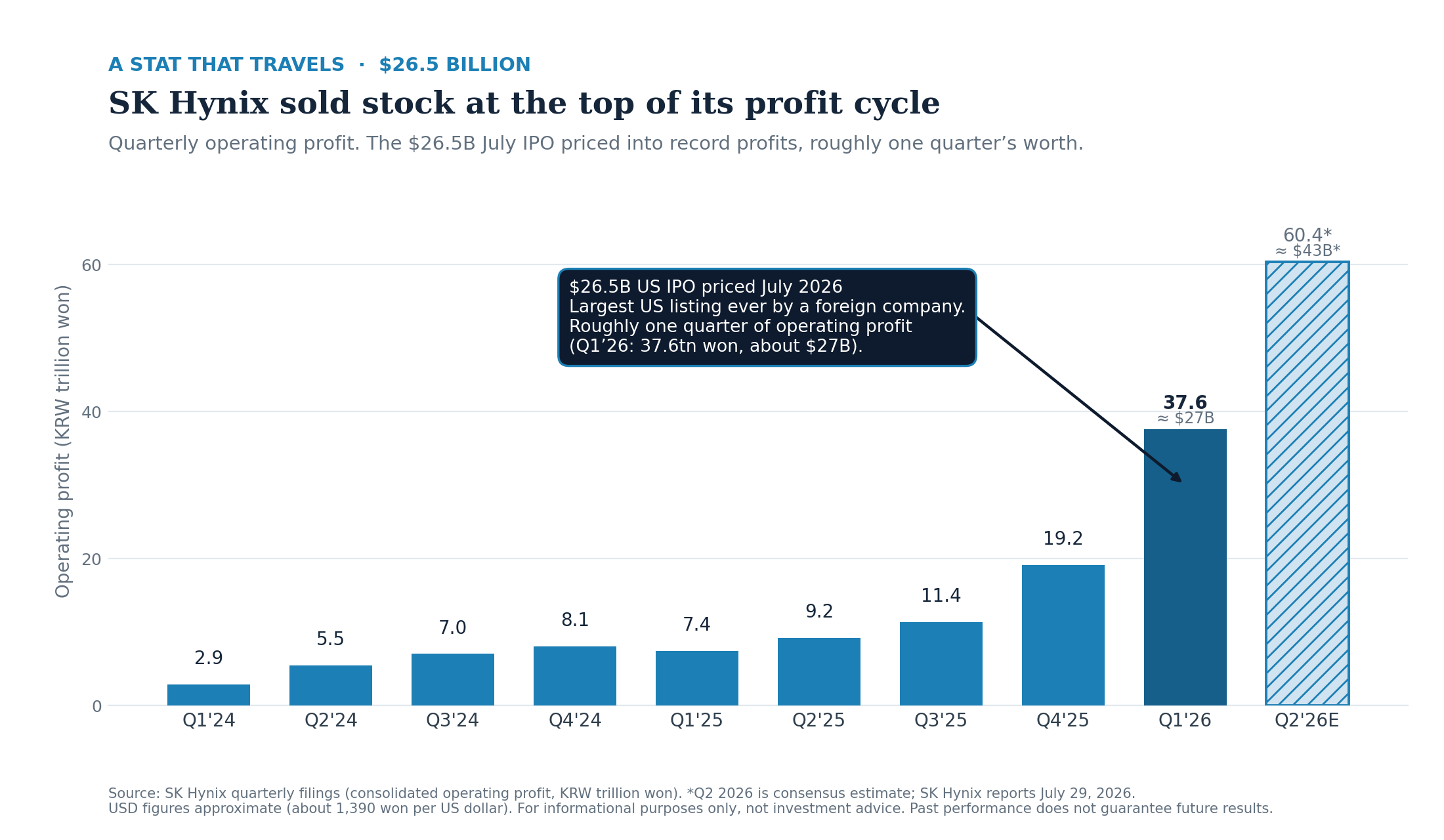
Source: SK Hynix. SK Hynix quarterly operating profit (KRW trillion). The $26.5B July IPO priced into record profits. Q2 26E reflects our estimate; SK Hynix reports July 29.
3forC: Three Talking Points for Clients
This week your clients will ask about: 1) the war, 2) the memory squeeze, and 3) Big Tech earnings. Let's dive in:
1) The War
There's a growing uneasiness that the Iran conflict won't end. Geopolitics is center stage with oil back above $90/barrel, squeezing low-income Americans the most at the pump with mid- and higher-income earners feeling pain in the risk-off stock and bond markets. Uncertainty is draining investor confidence and compressing valuation multiples, more than offsetting a bright start to earnings season that is lifting earnings estimates. Energy and utilities are leading as investors rotate toward sectors that historically benefit from higher commodity prices and a more defensive backdrop. On Wednesday, Fed Chair Kevin Warsh announces whether the FOMC will keep the Fed funds rates flat at 3.50% to 3.75% (~2/3 odds) or hike +25bp (~1/3 odds) ahead of the rising energy-driven inflation prints.
2) The Memory Squeeze
Memory is cyclical. High-bandwidth memory is sold out for 2026, Q2 DRAM pricing is up +58-63%, and memory makers are posting record results, led by SK Hynix, which reported a Q1 operating margin of 72% set to rise even more in Q2, which gets reported July 29th. Part of Meta's capex increase is due to memory. We expect the shortage to continue through 2027 with rising production easing prices in 2028.
3) Big Tech Earnings
Meta is our largest Founder-Led buyer of memory, and we hear from AI memory buyers and sellers this week. Bloom Energy's Founder KR Sridhar reports Tuesday. Meta's Founder Mark Zuckerberg, Robinhood's Founder Vlad Tenev, and Fortinet's Founder Ken Xie report Wednesday along with the Fed, Microsoft, and SK Hynix. Reddit's Founder Steve Huffman reports Thursday along with Apple, Amazon, and Samsung.
Our forward-looking commentary is what we believe, not what's guaranteed. Results can and will surprise.
Industry Insight
The Memory Cycle
Memory is having its best year in a generation, and that is precisely why we are writing about the other side of it. Conventional DRAM contract prices rose an estimated 58% to 63% in the second quarter, NAND rose 70% to 75%, the largest quarterly jumps in a decade according to TrendForce, and the high-bandwidth memory (HBM) that feeds AI accelerators is sold out for 2026. The results have been notable. SK Hynix posted a record first quarter, with a 72% operating margin, and reports Q2 on July 29 with consensus pointing to another record; Samsung's early-July preview was also a record; and the memory stocks, after a sharp mid-July drop, have rebounded to near their prior highs. The bulls, including SK Hynix, Samsung, and Micron's own management, argue the shortage worsens through 2027 and beyond as AI demand outruns supply. For now, the tape agrees with them.
We take that demand seriously. We are simply not convinced memory has stopped being cyclical, and three things keep us honest. First, the record prices are pulling forward record capacity: Samsung and SK Hynix are committing on the order of half a trillion dollars to new Korean fabs, and Micron is lifting US investment toward $250 billion, much of it landing in 2027 and 2028. Second, forecasters already disagree about how long the boom runs. TrendForce sees the pace of price gains cooling in the second half, with DRAM up an estimated 13% to 18% in the third quarter versus 58% to 63% in the second, while KeyBanc still sees DRAM up 15% to 20% and NAND up 30% to 40%; Goldman Sachs has warned that HBM supply growth could outpace demand as soon as 2026, and Bloomberg Intelligence has suggested oversupply could arrive by 2028. When the sharpest shops on the Street cannot agree whether prices decelerate or keep climbing, that uncertainty is itself the cyclical risk. Third, and simplest, every prior memory cycle has ended the same way, with capacity arriving late, demand normalizing, and prices falling faster than anyone modeled.
The more revealing signal is behavioral. Even with sentiment euphoric, SK Hynix sold $26.5 billion of stock to the US public in July, coming off a record first quarter and just days ahead of its next report. Selling equity at the very top of the pricing cycle, when your own numbers look their best, is a reasonable move for a seller. None of this means the shortage is fake. Demand is real and, for now, still growing. It does suggest the boom will run in cycles, the way memory always has, even if the headlines make it sound permanent.
For FFF, the takeaway is simple. The pure memory producers, Micron, Samsung, and SK Hynix, are not Founder-Led and sit outside our universe by design. We play this cycle through the Founder-Led companies on the demand side of it, above all Meta (META), whose founder is one of the largest buyers of memory on earth. Expensive memory is a cost today; when the cycle turns and memory gets cheaper, that becomes a margin and free-cash-flow tailwind for the buyers. We would rather own the customer than the commodity.
Portfolio Pulse
Founders in Their Own Words
Jensen Huang, in his first-ever post on X, July 24, 2026
“AI will transform every industry, power every company, and be built by every country. Open models strengthen safety and cybersecurity, accelerate innovation and diffusion, and enable sovereignty.”
Our take. Jensen Huang runs one of the world's most valuable companies and had never once posted on X. For his debut he chose open-weight AI. Huang used it to share a letter NVIDIA co-signed with fellow Founder-Led companies we own, including Meta, Palantir, and Dell, arguing that American AI leadership should rest on both open and closed models rather than a single frontier system. For us the relevant part is breadth: the more countries and companies that build their own models, the more demand there is for the compute, networking, and memory underneath, which is what this whole issue is about. We take no side on AI policy, but it is striking how publicly these Founders are now making their case.
Conviction Corner
RIA Q&A on FFF's Role in a Portfolio
Q. My clients already own SPY, QQQ, or VOO. Don't they already have exposure to Founder-Led companies?
A. Less than you might think. The most popular US equity ETFs by assets under management carry surprisingly little Founder-Led exposure: SPY and VOO sit around 16%, QQQ around 21%, and a value fund like VTV closer to 3%. Even the most founder-heavy large funds top out near 30%. FFF is 100% Founder-Led by design.
Macro Minutes
U.S. Economic Releases · Week of July 27 - 31
What We're Watching
The Federal Reserve decides on July 28 and 29,
Chair Warsh's second meeting, with energy back as the market's swing factor. The Iran conflict flared again in July, sending Brent crude from around $70 early in the month back toward $100 and leaving it elevated near $90, which feeds straight into headline inflation and has revived the case for tighter policy. A hold in the 3.50% to 3.75% range is still the base case, but market-implied odds of a hike have climbed to roughly one in three, with effectively no odds of a cut. It would be the fifth consecutive hold if the Committee stands pat. June CPI, released July 14, still carried the earlier energy unwind, with headline inflation at 3.5% and core at 2.6%, but that reading looks backward after the July move in oil, and the memory and AI-hardware price impulse this issue describes points the same way. One scheduling note: the Committee decides on CPI alone this time, because June PCE is not released until July 31, after the meeting. Meta and Microsoft both report that same afternoon.
Our take. This is the tension of the summer in one meeting. June's data still points down, but the forward risk has flipped: the war has put energy back in play, and a second inflation impulse is building in memory and other AI hardware. Both push the same way. That combination has revived the case for a hike and pushes any path to rate cuts further out than the market assumed a month ago. The picture is fluid, and a durable ceasefire would change it quickly. We position by process rather than by prediction, and we would rather see these pressures ease on their own than count on it.
Earnings Edge
FFF Holdings Reporting
Dr. KR Sridhar
Tuesday, July 28
After a beat and raise Q1, we believe Founder KR Sridhar could report another quarter of record sales and margins in Q2. Bloom Energy, which bills its fuel cells as a fast, clean, and reliable source of on-site power for data centers, sold off recently on natural gas pipeline and air permitting delays at ORCL's Jupiter data center in New Mexico (2.45 GW of the 5.00 GW BE plans to supply annually). While BE can sell to other customers until permits are approved at its largest project, a recent short report has us watching for any gaps in its backlog.
Mark Zuckerberg, CEO
Wednesday, July 29
Meta is our largest holding, and with advertising holding up, all eyes will be on capex and memory costs. In Q1, Founder Mark Zuckerberg raised 2026 capex to $125-145 billion, partly on higher memory pricing, and the stock fell -10% before rebounding on enthusiasm for "Meta Compute." We will be listening for whether the capex range moves again and how management frames the memory-cost hit to margins and free cash flow.
Vlad Tenev, CEO
Wednesday, July 29
The Founder-run brokerage has expanded from equities into options, crypto, retirement, and prediction markets. We are concerned weakness in crypto could more than offset gains elsewhere. Key numbers will be net deposits, funded accounts, and net interest income. Longer term, we see crypto appreciating with inflation at roughly 3% to 5% a year, more like gold than a speculative trade.
Ken Xie, CEO
Wednesday, July 29
Ken Xie's company offers network security and firewalls. We are watching billings growth, commentary on the shift toward SASE and security operations, and for a read on enterprise security spending.
Steve Huffman, CEO
Thursday, July 30
The social platform monetizes through advertising and, increasingly, by licensing its content for AI training. The things to watch: daily active users, advertising growth, and traction in AI data licensing.
Michael Hsing, CEO
Friday, July 31
A Founder-led power-management chipmaker whose parts sit alongside the AI accelerators and memory this issue is about. We're focused on AI and enterprise-data demand, and content per system.
Tuesday, July 28
Wednesday, July 29
Thursday, July 30
Friday, July 31
Washington Wire
“I do not view a one-time change in prices from AI as necessarily being inflationary.”
Fed Chair Kevin Warsh, Senate Banking Committee testimony, July 15, 2026
Our take. Warsh keeps making the case that the AI build-out is disinflationary over time, and in his July testimony he took it straight to the memory story, arguing that a one-time step-up in chip prices is not the same thing as inflation. That view is being tested from two directions at once. Memory makers are guiding prices higher into the second half rather than lower, and, more pressing for the Fed this week, the war has pushed oil back up, a classic energy-driven inflation shock. The hardware impulse may prove one-time, as Warsh argues, and we still expect memory to move in cycles. Energy is the harder call: if the conflict flares again, higher oil can keep headline inflation elevated well beyond a single print. A credible, independent Fed that keeps expectations anchored is exactly what markets need while both pressures play out.
Investing involves risk, including possible loss of principal, high volatility from Founder-Led stock concentration, growth-style investing, Software exposure, and key-person risk (the risk a Founder leaves). Carefully consider the Fund's investment objectives, risks, charges, and expenses before investing by reading the prospectus at http://FounderETFs.com/FFF.
FFF is the Founders 100 ETF, an actively managed fund with a 0.75% net expense ratio that invests primarily (at least 90%) in Founder-Led, US-listed common stocks or REITs selected via proprietary criteria, with no assurance of achieving its capital appreciation objective. Shares trade at market price, which may be at a premium or discount to NAV, are redeemable only in Creation Units of 10,000 shares, and are not insured or guaranteed by any agency, including FDIC or FRB. ETFs may trigger capital gains; consult your tax and investment advisors.
Past performance does not guarantee future results. Bain & Company charts show historical indexed total shareholder return of S&P 500 Index stocks (Founder-Led vs. non-founder-led, 1990 to 2014 and 2015 to 2024), are illustrative only, and do not represent FFF performance (first traded 12/18/25, limited history). Founder ETFs is not affiliated with or endorsed by Bain. Founder ETFs defines "Founder-Led" as a firm with an original Founder serving as a chief officer; Bain's definition also includes Founder board members.
Not investment advice or a solicitation to buy or sell any security. All data including portfolio weights, sector weights, and one-month price moves referenced in this issue are as of 7/17/26, subject to change without notice, and are not recommendations. References to prior technology investment cycles and historical infrastructure build-outs are illustrative and do not predict future results; estimates of future AI infrastructure investment reflect the Adviser's opinion. Company financial figures are sourced from SEC filings; the APR Energy transaction value is an estimate reported in the press and was not officially disclosed. References to litigation involving xAI reflect allegations that are unproven and contested. Earnings dates are company-announced and subject to change. This communication may contain forward-looking statements based on current expectations and assumptions and actual results. These statements are subject to risks and uncertainties, and actual results may differ materially from those anticipated. We undertake no obligation to update these statements as a result of new information or future events. Concentration in Founder-Led companies does not guarantee superior performance and may introduce additional risks, including governance risk (a Founder making a poor strategic decision) and concentration risk. Distributed by Vigilant Distributors LLC.
Founder Factor · Weekly Newsletter