Watt's Next
Power has become the defining constraint on the AI build-out. This week Elon Musk spent an estimated $1 billion on a fleet of mobile turbines, NVIDIA anchored a 140-megawatt AI factory in Japan, and BlackRock opened earnings season with record results as inflation cooled to 3.5%. Inside: the power bottleneck, our Capital One spotlight, the AI-infrastructure selloff, and the week's Founder-Led earnings.
Opening Bell
Welcome! At Founder ETFs, we help RIAs close the Founder Gap hiding in their clients' portfolios.
Founder-Led S&P stocks outperformed non-founder-led: 3.1x from 1990 to 2014 and 2.1x from 2015 to 2024, according to Bain & Company.
Yet our research shows the 300 largest US equity ETFs (90% category AUM) own just 12.55% Founders. We built the Founders 100 ETF (100% Founders) to close that gap.
Michael and I aren't a faceless asset manager. When you call, email, or text, you get us.
We're your partners: sharing our fundamental research, our highest-conviction Founder ideas, and following our disciplined, 80%+ rules-based process designed to help remove emotional decision making during periods of fear and greed. As two of the largest $FFF shareholders, we plan to be fully invested alongside you for the next 30 years. Your success is our success.
This week the tape did something healthy. After a historic first half for a handful of mega-cap names, money began to rotate into small caps, financials, industrials, and energy. The Russell 2000 just posted its best first half since 1991. We welcome a broadening market; it is exactly the environment in which fundamentals decide winners.
The rotation also plays to a fact about FFF that surprises many advisors: while the Technology sector is more than 50% of the portfolio, FFF invests in 10 of the 11 GICS sectors, including Financials, Industrials, Materials, Real Estate, and Health Care. All five of those sectors have Founders reporting this week: Blackstone (BX) and Capital One (COF) in Financials, Waste Connections (WCN) and Comfort Systems (FIX) in Industrials, Steel Dynamics (STLD) in Materials, Essential Properties (EPRT) in Real Estate, and Viking Therapeutics (VKTX) in Health Care.
We don't chase rotations. FFF reconstitutes quarterly on fresh fundamental data following earnings season. Capital One reports Tuesday. We continue to watch our 100 Founders report one by one.
We are here to answer your questions. Welcome to Issue #10.
Michael & Lauren
Founder Spotlight
Richard Fairbank at Capital One (COF)
Co-Founder, Chairman & CEO · Capital One Financial (COF) · Reports Q2 Tuesday, July 21
Richard Fairbank co-founded Capital One in 1994 on a then-radical idea that a credit card business could be built on data, reportedly collecting more data on Americans than anyone outside the FBI, and experimentation. His "Information-Based Strategy" (IBS), which ran thousands of tests to price risk at the level of the individual customer, reinvented consumer lending and built one of the largest and most successful US credit card issuers. Three decades later, Capital One combines a scaled national card franchise, a low-cost digital bank, and, with the acquisition of Discover, a global network supporting durable earnings growth and a valuation re-rating we believe the market has yet to fully price.
We believe Capital One is well positioned to deliver durable double-digit EPS growth, supported by the Discover network integration, an improving consumer credit backdrop, a structural funding advantage, and aggressive capital return. Our $250 price target is based on a 10x P/E multiple on our 2027 adjusted EPS estimate of $25, implying ~20% upside.
With the acquisition of Discover, Capital One now owns something almost no other card issuer has: its own payments network. The core of the thesis is vertical integration. Owning the network will lower transaction costs, deepen merchant relationships, and capture economics that previously left the building. Under the Volcker Rule, Capital One is free to offer uncapped rewards on debit card spending routed over its own network, a product advantage no major competitor can easily replicate. We believe migrating volume from card networks onto Discover's rails will be a multi-year value driver.
The data advantage compounds it. Three decades of IBS underwriting gives Capital One a proprietary view of consumer risk that supports through-the-cycle pricing discipline. With inflation cooling and gas prices falling, the setup for the consumer, and therefore for credit costs, is improving at the margin, and reserve releases or simply stable charge-offs would flow directly to earnings.
The funding model is a quiet differentiator. Capital One built one of the largest digital banks in the country, giving it a national, branch-light deposit base that funds card receivables at attractive cost. Deposit funding plus network ownership moves the company closer to a closed-loop model, with more of every swipe retained in-house.
Integration is the swing factor and the opportunity. Bringing Discover onto Capital One's technology platform carries execution cost, but it also unlocks announced expense and network synergies, and every quarter of clean execution de-risks the earnings path toward our 2027 estimate.
Capital allocation provides an additional tailwind. The combined franchise generates substantial excess capital, and Fairbank has historically returned it aggressively; buybacks at the current valuation are meaningfully accretive to per-share earnings while preserving flexibility to invest in the network.
Risks We're Watching
Key risks include a deterioration in consumer credit and rising charge-offs, integration risk from the Discover combination, competitive and regulatory pressure on interchange and network economics, sensitivity to unemployment and the rate cycle, and key-person risk (the risk a Founder leaves).
A Stat That Travels
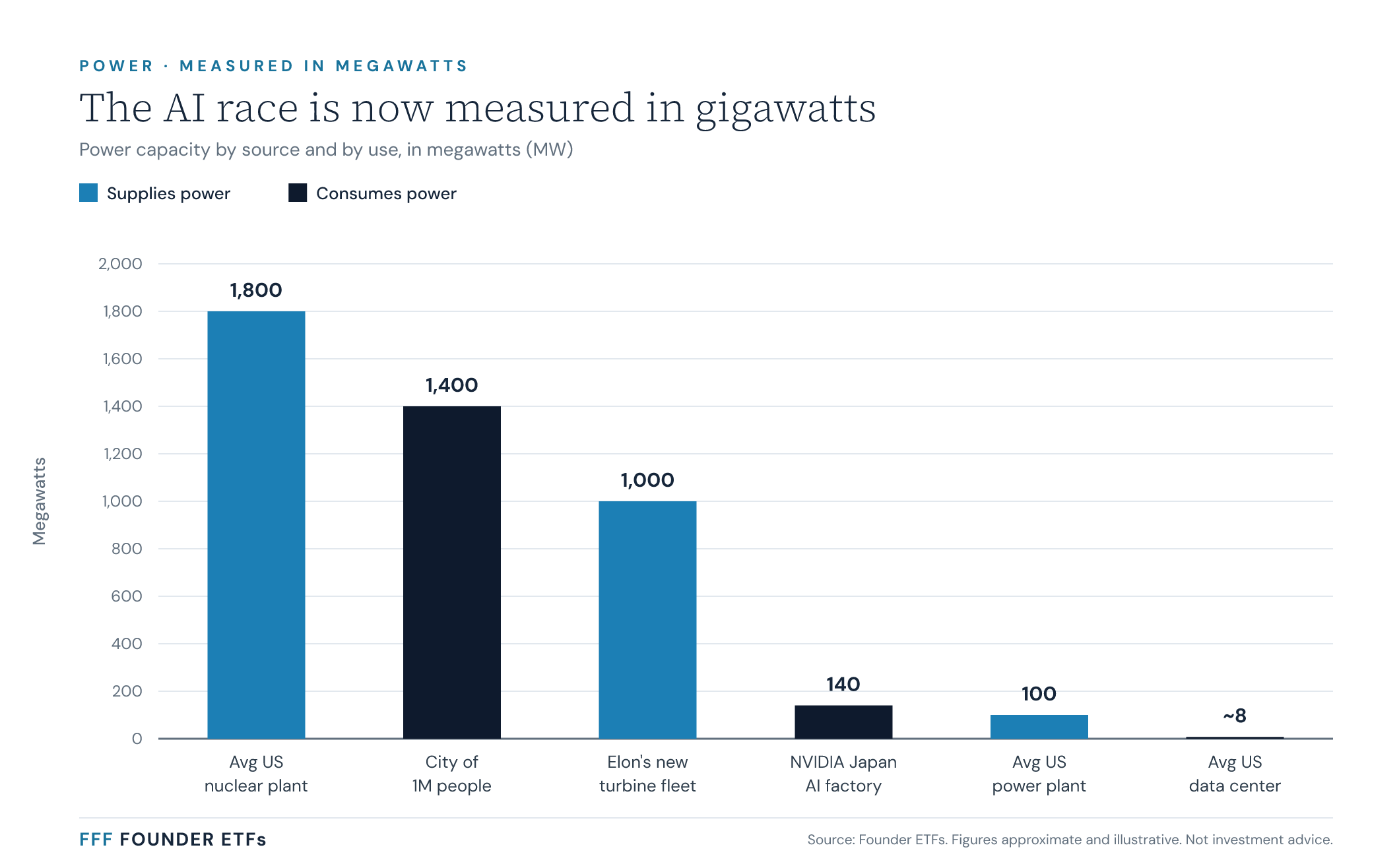
1 Gigawatt
The AI race is now measured in gigawatts This is the power capacity of the mobile turbine fleet one Founder bought this week to feed his AI supercomputers, roughly the output of a mid-sized nuclear reactor, but on wheels. It is the clearest sign yet that the AI build-out has hit a power wall, where compute is gated by how many megawatts you can plug in. NVIDIA's newest AI factory in Japan is similarly quoted in terms of power at 140 megawatts. Though energy prices just fell -6%, cooling headline inflation to 3.5%, the AI economy is preparing to ramp its consumption of electricity to a scale never before seen. FFF owns the Founder-Led companies on both sides of that equation, the ones driving the demand and the ones supplying it. On the demand side sits: NVIDIA (NVDA), Founder Jensen Huang, at the center of nearly every AI build-out on earth; Dell (DELL), Founder Michael Dell, assembling the AI servers that fill the racks; Palantir (PLTR), Founder Alex Karp, and the neocloud operators CoreWeave (CRWV) and Nebius (NBIS), Founders Michael Intrator and Arkady Volozh, renting the compute. On the supply side sits: Bloom Energy (BE), Founder KR Sridhar, whose on-site fuel cells can power a data center without waiting on the grid; Vicor (VICR), Founder Patrizio Vinciarelli, whose power-delivery components sit between the wall and the processor; and Nextracker (NXT), Founder Dan Shugar, in utility-scale solar. New gas turbines quickly run into permitting, air-quality, and NIMBY concerns. Though xAI disputes the claim, environmental groups have filed a lawsuit against xAI's Colossus factory near Memphis claiming its turbines ran without the proper permits. The Founders who can navigate these limits will have an advantage.
3forC: Three Talking Points for Clients
This week your clients will ask about: 1) Power, 2) AI Infrastructure, and 3) Inflation & Earnings. Let's dive in:
1) Power
Power has become the scarcest AI input. This week Elon Musk personally acquired APR Energy, an operator of gas turbines on wheels, capable of generating more than one gigawatt of power, in a ~$1 billion deal to feed his xAI supercomputers. Our portfolio owns Founder-Led companies on both the supply and demand sides of the power equation.
2) AI Infrastructure
On July 16, Japan's government, its industrial leaders, and NVIDIA (NVDA), our largest holding, launched the world's first national AI infrastructure. The flagship is an NVIDIA "AI factory" built with partner Noetra, 27,500 next-generation Rubin GPUs delivering 140 megawatts of computing capacity, to power Japan's national push into AI infrastructure. While the order is modest for NVDA, strategically it signals that sovereign AI is becoming a category.
3) Inflation & Strong Earnings
Cooling inflation alongside strong corporate earnings is a constructive backdrop for growth equities. June CPI cooled to 3.5% year over year, below the 3.8% the Street expected, the first decline in five months, led by a -6% drop in energy prices. Deflation gives Fed Chair Kevin Warsh's room to consider a rate cut later this year. The banks, brokers, and BlackRock (BLK) opened earnings season with record results, also supportive of both Wall Street and Main Street.
Our commentary is what we believe, not what's guaranteed. Results, data, and policy can and will surprise.
Industry Insight
Conviction Through the Correction - AI Infrastructure
Excluding Dell (DELL), our AI infrastructure holdings, nearly 8% of the portfolio, fell sharply over the past month, with single-name declines of -24% to -44%. The magnitude of the selloff stands in sharp contrast to the strength of the fundamentals and our long-term conviction. Dell itself, a 6% position, is the exception, down just -3% over the same period.
FFF AI Infrastructure Holdings: One-Month Price Moves
| Company | Ticker | % of FFF | 1-Month Move |
|---|---|---|---|
| Dell Technologies | DELL | 6.00% | -3% |
| Oracle | ORCL | 4.48% | -31% |
| Bloom Energy | BE | 1.58% | -35% |
| Nebius Group | NBIS | 0.92% | -38% |
| CoreWeave | CRWV | 0.90% | -38% |
| IREN | IREN | 0.33% | -44% |
| TeraWulf | WULF | 0.21% | -37% |
| Cipher Mining | CIFR | 0.20% | -38% |
| Applied Optoelectronics | AAOI | 0.20% | -37% |
| ACM Research | ACMR | 0.13% | -24% |
Source: Founder ETFs. Weights and one-month price returns as of 7/17/26. Holdings and weights are subject to change and are not recommendations.
The stocks of the strongest secular winners rarely move higher in a straight line. During previous technology investment cycles, including the internet, smartphones, and cloud computing, industry leaders routinely experienced -30% to -50% corrections before ultimately reaching much higher valuations. Volatility is often the price investors pay to participate in long-duration growth trends, and some of the best opportunities emerge when expectations reset.
Following extraordinary gains, investors took profits amid concerns that hyperscalers may be overspending on AI infrastructure, returns on those investments could disappoint, and valuations had become stretched. The result has been a broad correction across the AI infrastructure ecosystem despite ongoing strong fundamentals.
Our five-year AI infrastructure thesis remains unchanged. AI demand continues to accelerate while the supply of compute capacity remains constrained, driving sustained investment across the AI stack. Echoing to the buildout of railroads and the electric grid, we believe annual US AI infrastructure investment will exceed $1 trillion by 2030, creating long-lived assets that generate cash flows for decades. Whether enterprises are training frontier models or deploying AI agents, AI requires massive investments in computing power, networking, optical components, power management, cooling, and electricity. Those foundational requirements have not changed.
None of this is a promise of a rebound. Corrections can deepen, expectations can keep resetting even when fundamentals hold, and past technology cycles are illustrative, not predictive. What we control is process: FFF reconstitutes quarterly on fresh fundamental data, and we size positions by rules, not by nerves. Key risks across these holdings include the pace of hyperscaler capital spending, customer concentration, execution and financing risk at earlier-stage operators, power and permitting constraints, and key-person risk (the risk a Founder leaves).
Portfolio Pulse
Founders in Their Own Words
“Every nation needs to own the production of its own intelligence. ”
Our take. Jensen has turned "Sovereign AI" from a slogan into a sales channel. Japan is the latest nation to conclude that AI infrastructure is national infrastructure, and that the compute foundation should be built at home. For our second largest holding, this supports the case that AI demand is broader and more durable than any single hyperscaler's capex budget. While the value of a 27,500-GPU order is relatively small, it sets an important precedent that we expect other governments to follow.
“We haven't seen any real change in credit quality.”
Our take. As we argued in Issue #9, we believe the private-credit "controversy" has been overblown. Last Wednesday, Larry Fink's Q2 comments strengthened our views. Credit conditions have stabilized, and BlackRock's net private credit inflows exceeded $6 billion in the quarter as institutional demand more than offset any residual selling by retail investors. From our perspective, this is the market repricing a specific corner of risk in a contained way, not the start of a credit crisis.
Conviction Corner
RIA Q&A on FFF's Role in a Portfolio
Q. Why does it matter whether a CEO founded the company or was hired?
A. We believe it matters enormously, and the data backs us up. Bain & Company research found that Founder-Led companies within the S&P 500 outperformed non-founder-led companies 3.1x from 1990 to 2014 and 2.1x from 2015 to 2024. The intuition is straightforward: Founders think in decades, not quarters, with the vision, conviction, and grit to build from zero to one. Hired CEOs manage. Founders build what lasts.
This issue is a case study in becoming unstoppable: one Founder spending his own billion dollars on power turbines, another sparking the buildout of sovereign AI, and a third betting three decades of market-leading data on a payments network he now owns.
Past performance does not guarantee future results. See Disclosures for the Bain & Company methodology and important information.
Macro Minutes
U.S. Economic Releases · Week of July 20 - 25
What We're Watching
June CPI - Tuesday, July 14
The most important release of the month arrived, and it came in cool. Headline CPI fell to 3.5% year over year from 4.2% in May, below the 3.8% consensus and the first decline in five months. On the month, prices fell 0.4%, the largest one-month drop since April 2020, led by a -6% decline in energy. This is the post-conflict energy unwind we outlined in Issue #5 finally showing up in the data. This week Housing is the cross-current to watch. Mortgage rates hit their highest level of 2026 and June pending home sales slumped, a reminder that even as inflation cools, high rates are still biting the most rate-sensitive area of the economy. Friday brings a fresh read: the Street expects June new home sales to rebound +4.6% to a 605,000 annual pace after a -7.3% drop in May. A soft housing tape strengthens the case for the Fed to begin easing; a rebound would show US consumers absorbing higher rates. Thursday's initial jobless claims are expected near 211,000, still historically low, and Friday's flash July PMIs are expected to show manufacturing firming to 54.4 from 53.9 with services near 51.5. Growth holding up while inflation cools would provide the soft-landing scenario that the market tends to reward.
Our take. The cooler June CPI reading of 3.5% was a relief. While we expect AI to lowers prices long run through productivity gains, the near-term ongoing conflict with Iran and the medium-term acceleration in energy demand from the AI buildout will require more power that keeps the economy at risk of higher energy prices, inflation, and rate hikes.
Earnings Edge
FFF Holdings Reporting
Larry Fink, Founder, Chairman & CEO
Wednesday, July 15
Last week was the best setup in Financials in decades. BlackRock beat and set all-time records. Revenue rose +31% year over year to more than $7 billion, ahead of expectations. Assets under management reached a record $15 trillion, +22%. Adjusted EPS was $13.91, above consensus, and the adjusted operating margin expanded to 45.9%. Organic base fee growth hit 10%, above the high end of management's 6-8% guide, precisely the outcome we forecast in Issue #9. Management raised full-year buyback guidance to $2 billion, and the stock rose ~7% on the day. This is the fundamental engine of our thesis running as designed.
Richard Fairbank
Tuesday, July 21
See this week's Founder Spotlight; watch consumer credit and the Discover network integration.
Stephen Schwarzman
Wednesday, July 23
We are listening for his private credit updates to echo those of Larry Fink.
Mark Millet
July 20
A Founder-Led industrial and onshoring bellwether.
Patrizio Vinciarelli
Tuesday, July 21
Power-delivery components, a direct tie to this issue's power theme.
Washington Wire
“It's one data point. There might be some that look at this morning's data and say, 'Oh, mission accomplished.' That is not my view.”
Fed Chair Kevin Warsh, House Financial Services Committee testimony, July 14, 2026
Our take. The June CPI print landed as Warsh sat before the House Financial Services Committee for his first testimony as Fed Chair, and he used the moment to temper expectations. He called high prices an "undue burden" on households and businesses and pledged a resolute commitment to price stability, while refusing to read one cool month as the job finished. That posture sets up the July 28-29 FOMC meeting. The energy-led disinflation we have described since Issue #5 gives the Fed room to consider cuts later this year, yet Warsh declined to signal any move, with the funds rate still in its 3.50% to 3.75% range. We expect political pressure for cuts to build with each cooling print. AI will be deflationary, raising productivity as it is fully integrated into the US economy in the coming years. A credible, independent Fed, responsive to near-term inflation and long-term deflation, is a critical element in America's ongoing success.
Investing involves risk, including possible loss of principal, high volatility from Founder-Led stock concentration, growth-style investing, Software exposure, and key-person risk (the risk a Founder leaves). Carefully consider the Fund's investment objectives, risks, charges, and expenses before investing by reading the prospectus at http://FounderETFs.com/FFF.
FFF is the Founders 100 ETF, an actively managed fund with a 0.75% net expense ratio that invests primarily (at least 90%) in Founder-Led, US-listed common stocks or REITs selected via proprietary criteria, with no assurance of achieving its capital appreciation objective. Shares trade at market price, which may be at a premium or discount to NAV, are redeemable only in Creation Units of 10,000 shares, and are not insured or guaranteed by any agency, including FDIC or FRB. ETFs may trigger capital gains; consult your tax and investment advisors.
Past performance does not guarantee future results. Bain & Company charts show historical indexed total shareholder return of S&P 500 Index stocks (Founder-Led vs. non-founder-led, 1990 to 2014 and 2015 to 2024), are illustrative only, and do not represent FFF performance (first traded 12/18/25, limited history). Founder ETFs is not affiliated with or endorsed by Bain. Founder ETFs defines "Founder-Led" as a firm with an original Founder serving as a chief officer; Bain's definition also includes Founder board members.
Not investment advice or a solicitation to buy or sell any security. All data including portfolio weights, sector weights, and one-month price moves referenced in this issue are as of 7/17/26, subject to change without notice, and are not recommendations. References to prior technology investment cycles and historical infrastructure build-outs are illustrative and do not predict future results; estimates of future AI infrastructure investment reflect the Adviser's opinion. Company financial figures are sourced from SEC filings; the APR Energy transaction value is an estimate reported in the press and was not officially disclosed. References to litigation involving xAI reflect allegations that are unproven and contested. Earnings dates are company-announced and subject to change. This communication may contain forward-looking statements based on current expectations and assumptions and actual results. These statements are subject to risks and uncertainties, and actual results may differ materially from those anticipated. We undertake no obligation to update these statements as a result of new information or future events. Concentration in Founder-Led companies does not guarantee superior performance and may introduce additional risks, including governance risk (a Founder making a poor strategic decision) and concentration risk. Distributed by Vigilant Distributors LLC.
Founder Factor · Weekly Newsletter