SpaceX Files, Karp Delivers: The Two Most Consequential Stories in Founder-Led Tech
Palantir's Rule of 40 hit 145% and its platform ran the Iran conflict. The SpaceX S-1 drops: Anthropic paying $1.25B a month, Google $920M, and the Starlink valuation math. Oracle reports tonight. The Iran deal and what a Hormuz reopening means for oil and rates.
Founder Spotlight
Alex Karp at Palantir
Our Palantir thesis is Karp will keep winning the behemoth contracts no one else can execute. Founder and CEO Alex Karp and his team are delivering AI capabilities to organizations whose various systems are too fractured, siloed, or incompatible for any other vendor to unify - the disparate, high-stakes environments like war, air traffic controls, or hospital records, where failure is not an option.
Palantir's Artificial Intelligence Platform (AIP) integrates large language models into an organization's private network, creating a live digital twin of its assets, employees, operations, supply chains, and external activities. Its Ontology layer turns fragmented data from complex, disparate environments into precise, actionable intelligence.
As a simple illustration, after mapping a lemonade stand, the platform can flag the need to order more lemons before an approaching heatwave, recommend optimal locations based on weekday sales patterns, and suggest tailored upsells at checkout based on each customer's checkout history. Now scale that to the Pentagon.
Palantir's AIP/Maven Smart System played a central role in US military operations during the Iran conflict, incorporating Claude and compressing decision-making from days to seconds. On the commercial side, US revenue grew +137% year-on-year in Q4, total contract value more than doubled, and the company's Rule of 40 score reached 145%, a level that is exceptionally rare at Palantir's scale. Our view differs from the Street: we expect Palantir to operate more efficiently over time with a leaner headcount, driving margin expansion and annual EPS beats through 2030.
At a premium valuation that reflects its growth potential, we see Palantir as a high-conviction Founder-led compounder for investors who want differentiated exposure to AI's most transformative, real-time enterprise capabilities.
A Stat That Travels
3.1×
Founder-led S&P 500 companies outperformed their non-founder peers over the 25 years through 2014, and by 2.1× over the most recent decade. Most ETFs barely own them. FFF owns the 100 founder-led names indices underweight or miss.

Source: Bain & Company analysis of companies in the 2014 S&P 500; indexed total shareholder return from 1990 to 2014.
Industry Insight
SpaceX: The IPO the Market Has Been Waiting For
SpaceX is one of the most complex and consequential IPOs in a generation, and the valuation math is anything but simple.
The Launch business, benchmarked against Rocket Lab at roughly 70x revenue, implies a launch segment worth somewhere around $700 billion. The S-1 also revealed something that surprised even the analysts: 76% of SpaceX's launches last year were internal: flying satellites for Starlink.
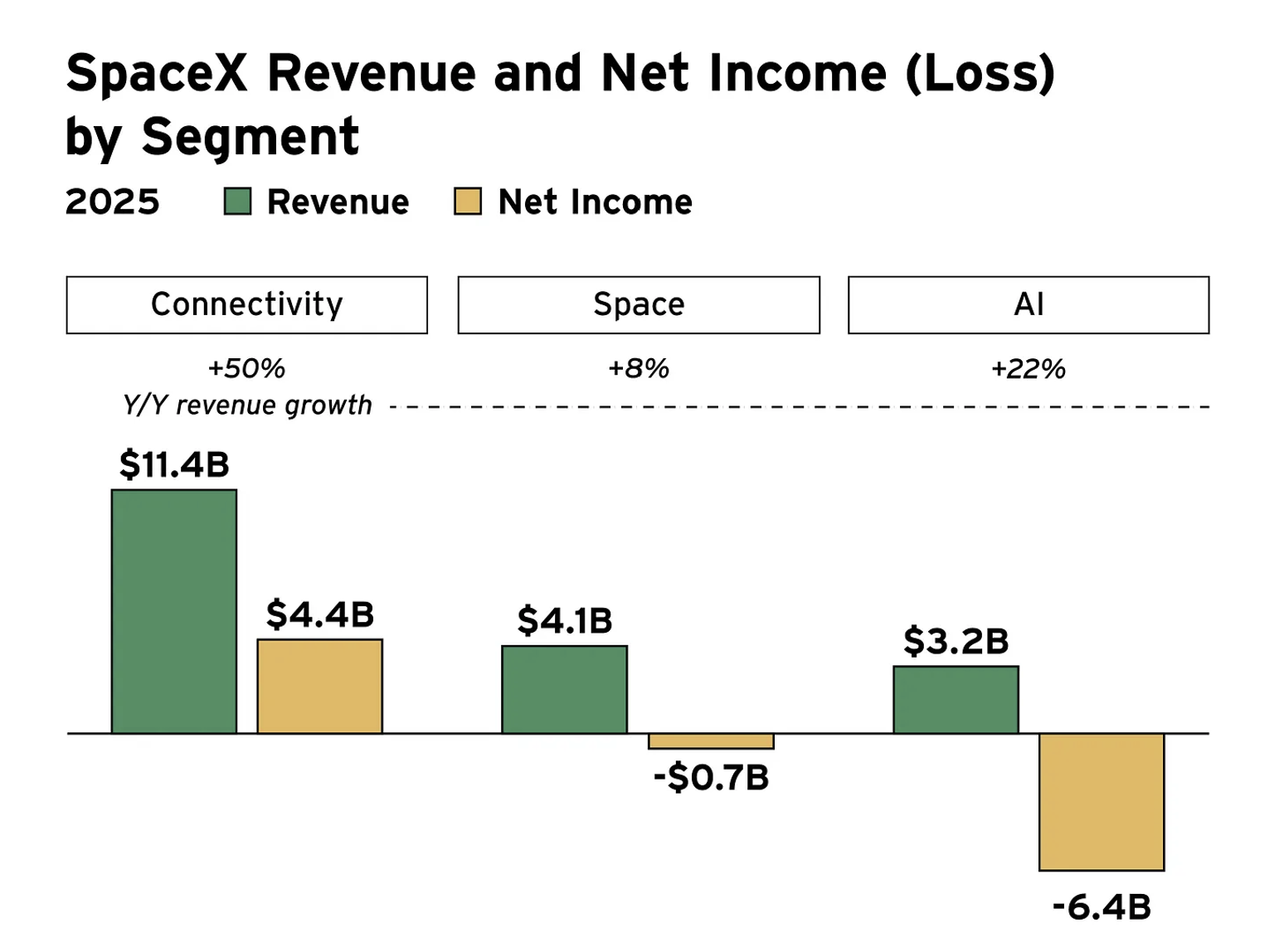
The real story is Starlink with a valuation for ~$600 using Netflix, Spotify, and Adobe as subscription comps.. Starlink generated nearly $9 billion in revenue in 2025 and is forecast to reach $14.5 billion in 2026, with a path toward $40 billion by 2031.
The Space AI Infrastructure business is earlier stage but could be the most consequential of all. Starship, SpaceX's next-generation rocket still in development, is the key: without dramatically cheaper and higher-capacity lift, the data center in orbit thesis doesn't close economically. Space data centers are the low cost providers with free cooling from the vacuum of space and 5x the solar panel efficiencies without night, but hyperscalers will need to sign up.
While the AI segment posted a -$2.5 billion operating loss in Q1 26, two landmark deals from Anthropic and Google are likely to swing the segment into profitability. Specifically, Anthropic is paying SpaceX $1.25 billion per month to rent Colossus 1 data center compute capacity, and Google is paying SpaceX $920 million per month through Q2 29. The two deals will generate +$6.5 billion in revenue per quarter. Assuming a 40% operating margin, that’s $2.6 billion in operating profit – swinging the segment from a deep loss to profit – before a single Starlink subscriber or rocket launch is counted.
Our Take SpaceX is the only company in the world building a closed-loop AI system with its own chips (Terafab), its own model (Grok), real-time proprietary data (X), global internet infrastructure (Starlink), reusable rockets (SpaceX), and physical robots (Tesla). No other Founder has vertically integrated all six layers. It’s an unstoppable moat. By our math, it will be a highly profitable combination. We are watching this IPO closely. We believe Elon Musk is a great Founder. Our participation on Friday comes down to price.
Portfolio Pulse
Founders in Their Own Words
During his keynote at NVIDIA GTC Taipei 2026
“When AI is no longer limited by the human population, a massive number of AI agents will use far more software tools than humans do. This is the best era to be a software company.”
Our take. Jensen said what the market hasn't fully priced yet. All 22 software companies in FFF's portfolio (~34% of AUM) are potential beneficiaries of a world with more AI agents than people. That's our contrarian thesis, and the Founder at the center of AI just confirmed it from the biggest stage in tech.
DASH 2026 Conference, June 9, 2026
“AI didn't create this complexity. It accelerated what was already there. The companies that win on AI won't just build better models, they'll build operational control around them.”
Our take. Pomel said this yesterday in New York, and every company racing to deploy AI agents is about to discover that observability is essential. You cannot run what you cannot see. A leader in AI operations, Datadog launched 100+ new capabilities at DASH, including fully autonomous Bits AI agents across development and security workflows.
Conviction Corner
RIA Q&A on FFF's Role in a Portfolio
How do you actually select the 100 holdings? Is this quantitative, discretionary, or somewhere in between?
A. Both, and the discipline between them is the point. We start with roughly 6,000 US-listed stocks, narrow to approximately 1,000 founder-led companies, take the 200 largest by free-float market cap, and select the final 100 based on fundamental strength. Narratives, momentum, and sentiment don't make the cut.
The process is designed to remove emotion at the moments it costs investors most — at market highs, when greed clouds judgment, and at market lows, when fear drives panic selling. Our rules do the heavy lifting: 80% or more of selection is rules-based, position sizes are capped at 7.5%, and the portfolio rebalances quarterly driven by earnings data. The remaining 20% or less is discretionary, reserved primarily for IPOs where a compelling founder-led opportunity emerges before the data fully matures.
One rule has no exceptions: if a founder departs, we sell.
The result is 100 founder-led companies unified by one repeatable process. Hired CEOs manage. Founders build what lasts.
Earnings Edge
FFF Holdings Reporting
Larry Ellison, Founder & CTO
After the close · Wed, June 10
Oracle is the original enterprise cloud, and now the trusted private AI infrastructure provider for governments, enterprises, and hyperscalers. We're watching four numbers tonight: OCI revenue growth against last quarter's +84% YoY pace, RPO - does the $553B backlog grow or plateau, cloud revenue against guided +46–50% growth, and FY2027 guidance - does Ellison confirm or raise the $90B target.
Washington Wire
“They both agreed, through me, to stop. Now we're in the final throes of what will be a very, very good deal that will not in any way allow nuclear weapons. The strait will open up right away, immediately upon signing, which could be in two or three days.”
President Donald Trump · To reporters, NBA Finals, New York · June 8
Our take. The next 90 days matter more than most investors appreciate. Oil fell -1% on this statement but accounted for >60% of May’s monthly CPI gain. A Strait of Hormuz reopening would be the single fastest deflationary catalyst available to the Fed right now. ExxonMobil's CEO has warned publicly that global spare capacity is running thin. If the conflict extends another three to six months without resolution, the global economy would face a stagflation scenario, a hard landing not just a temporary price spike. A structural repricing of energy would raise the cost of food, transport, manufacturing, and housing over time so its important that we sign a deal before autumn.
Investing involves risk, including possible loss of principal, high volatility from Founder-Led stock concentration, growth-style investing, Software exposure, and key-person risk (the risk a Founder leaves). Carefully consider the Fund's investment objectives, risks, charges, and expenses before investing by reading the prospectus at http://FounderETFs.com/FFF.
FFF is the Founders 100 ETF, an actively managed fund with a 0.75% net expense ratio that invests primarily (at least 90%) in Founder-Led, US-listed common stocks or REITs selected via proprietary criteria, with no assurance of achieving its capital appreciation objective. Shares trade at market price, which may be at a premium or discount to NAV, are redeemable only in Creation Units of 10,000 shares, and are not insured or guaranteed by any agency, including FDIC or FRB. ETFs may trigger capital gains; consult your tax and investment advisors.
Past performance does not guarantee future results. Bain & Company charts show historical indexed total shareholder return of S&P 500 Index stocks (Founder-Led vs. non-founder-led, 1990 to 2014 and 2015 to 2024), are illustrative only, and do not represent FFF performance (first traded 12/18/25, limited history). Founder ETFs is not affiliated with or endorsed by Bain. Founder ETFs defines "Founder-Led" as a firm with an original Founder serving as a chief officer; Bain's definition also includes Founder board members.
Not investment advice or a solicitation to buy or sell any security. All data including portfolio weights, sector weights, and one-month price moves referenced in this issue are as of 7/17/26, subject to change without notice, and are not recommendations. References to prior technology investment cycles and historical infrastructure build-outs are illustrative and do not predict future results; estimates of future AI infrastructure investment reflect the Adviser's opinion. Company financial figures are sourced from SEC filings; the APR Energy transaction value is an estimate reported in the press and was not officially disclosed. References to litigation involving xAI reflect allegations that are unproven and contested. Earnings dates are company-announced and subject to change. This communication may contain forward-looking statements based on current expectations and assumptions and actual results. These statements are subject to risks and uncertainties, and actual results may differ materially from those anticipated. We undertake no obligation to update these statements as a result of new information or future events. Concentration in Founder-Led companies does not guarantee superior performance and may introduce additional risks, including governance risk (a Founder making a poor strategic decision) and concentration risk. Distributed by Vigilant Distributors LLC.
Founder Factor · Weekly Newsletter